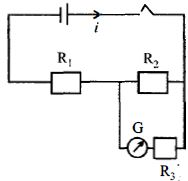
A battery of internal resistance $4$ $\Omega$ is connected to the network of resistances as shown. In order to give the maximum power to the network, the value of $R$ (in $\Omega $) should be
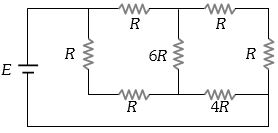
IIT 1995, Diffcult

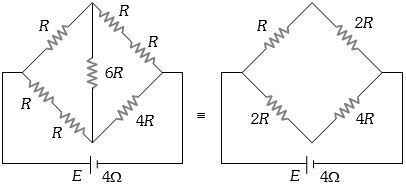

Download our appand get started for free
Experience the future of education. Simply download our apps or reach out to us for more information. Let's shape the future of learning together!No signup needed.*
Similar Questions
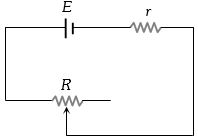
- 1A battery of $e.m.f.$ $E$ and internal resistance $r$ is connected to a variable resistor $R$ as shown here. Which one of the following is trueView Solution
- 2When a wire of uniform cross-section $a$, length $l$ and resistance $R$ is bent into a complete circle, resistance between any two of diametrically opposite points will beView Solution
- 3The current from the battery in the given circuit is ................ $A$View Solution
- 4View SolutionThe material of fuse wire should have
- 5A certain piece of silver of given mass is to be made like a wire. Which of the following combination of length $(L)$ and the area of cross-sectional $(A) $ will lead to the smallest resistanceView Solution
- 6To find the resistance of a galvanometer by the half deflection method the following circuit is used with resistances $R_1 = 9970\,\Omega,$ $R_2 = 30\,\Omega$ and $R_3 = 0\,\Omega.$ The deflection in the galvanometer is $d$. With $R_3 = 107\,\Omega$ the deflection changed to $\frac {d}{2}$The galvanometer resistance is approximately ............... $\Omega$View Solution
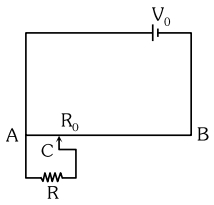
- 7The sliding contact $C$ is at one fourth of the length of the potentiometer wire $( AB )$ from $A$ as shown in the circuit diagram. If the resistance of the wire $AB$ is $R _0$, then the potential drop $( V )$ across the resistor $R$ isView Solution
- 8$10$ resistors, each of resistance $R$ are connected in series to a battery of $emf$ $E$ and negligible internal resistance. Then those are connected in parallel to the same battery, the current is increased $n$ times. The value of $n$ is :View Solution
- 9View SolutionA potential difference is applied across the ends of a metallic wire. If the potential difference is doubled, then the drift velocity
- 10One $kg$ of water, at $20\,^oC$, is heated in an electric kettle whose heating element has a mean (temperature averaged) resistance of $20\, \Omega $. The rms voltage in the mains is $200\, V$. Ignoring heat loss from the kettle, time taken for water to evaporate fully, is close to.......... $\min$ [Specific heat of water $= 4200\, J/kg\, ^oC$), Latent heat of water $= 2260\, k\,J/kg$]View Solution