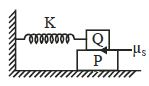
A block $P$ of mass $m$ is placed on a smooth horizontal surface. A block $Q$ of same mass is placed over the block $P$ and the coefficient of static friction between them is ${\mu _S}$. A spring of spring constant $K$ is attached to block $Q$. The blocks are displaced together to a distance $A$ and released. The upper block oscillates without slipping over the lower block. The maximum frictional force between the block is
Diffcult
Download our app for free and get started
$\omega=\sqrt{\frac{\mathrm{K}}{2 \mathrm{m}}}$
Maximum acceleration $=\omega^{2} \mathrm{A}=\frac{\mathrm{KA}}{2 \mathrm{m}}$
Friction between blocks $=$ force on lower block
$=m a=\frac{K A}{2}$

Download our appand get started for free
Experience the future of education. Simply download our apps or reach out to us for more information. Let's shape the future of learning together!No signup needed.*
Similar Questions
- 1The force constants of two springs are ${K_1}$ and ${K_2}$. Both are stretched till their elastic energies are equal. If the stretching forces are ${F_1}$ and ${F_2}$, then ${F_1}:{F_2}$ isView Solution
- 2If $x=5 \sin \left(\pi t+\frac{\pi}{3}\right) \mathrm{m}$ represents the motion of a particle executing simple harmonic motion, the amplitude and time period of motion, respectively, areView Solution
- 3The potential energy of a simple harmonic oscillator of mass $2\, kg$ in its mean position is $5\, J.$ If its total energy is $9\,J$ and its amplitude is $0.01\, m,$ its time period would beView Solution
- 4Displacement between maximum potential energy position and maximum kinetic energy position for a particle executing $S.H.M.$ isView Solution
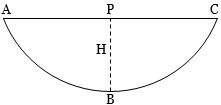
- 5A simple pendulum with a bob of mass $‘m’$ oscillates from $A$ to $ C$ and back to $A$ such that $PB$ is $H.$ If the acceleration due to gravity is $‘g’$, then the velocity of the bob as it passes through $B$ isView Solution
- 6Velocity at mean position of a particle executing $S.H.M.$ is $v$, they velocity of the particle at a distance equal to half of the amplitudeView Solution
- 7A body of mass $5\; kg$ hangs from a spring and oscillates with a time period of $2\pi $ seconds. If the ball is removed, the length of the spring will decrease byView Solution
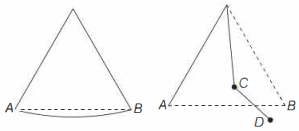
- 8A simple pendulum oscillates freely between points $A$ and $B$. We now put a peg (nail) at the point $C$ as shown in above figure. As the pendulum moves from $A$ to the right, the string will bend at $C$ and the pendulum will go to its extreme point $D$. Ignoring friction, the point $D$View Solution
- 9A body executes simple harmonic motion under the action of a force $F_1$ with a time period $(4/5)\, sec$. If the force is changed to $F_2$ it executes $SHM$ with time period $(3/5)\, sec$. If both the forces $F_1$ and $F_2$ act simultaneously in the same direction on the body, its time period (in $seconds$ ) isView Solution
- 10A simple pendulum hanging from the ceiling of a stationary lift has a time period $T_1$. When the lift moves downward with constant velocity, the time period is $T_2$, thenView Solution