The three resistance of equal value are arranged in the different combinations shown below. Arrange them in increasing order of power dissipation.
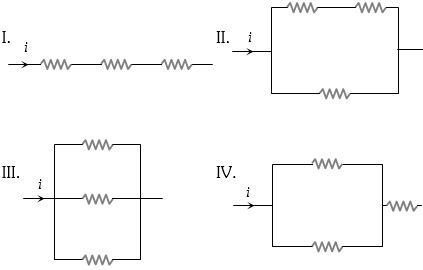
IIT 2003, Medium


Download our appand get started for free
Experience the future of education. Simply download our apps or reach out to us for more information. Let's shape the future of learning together!No signup needed.*
Similar Questions
- 1Three light bulbs of $40\, W$, $60\, W$ and $100\, W$ are connected in series with $220\, V$ source. Which one of the bulbs will glow brightest ............ $W$View Solution
- 2A cell can be balanced against $110\,\, cm$ and $100\,\, cm$ of potentiometer wire, respectively with and without being short circuited through a resistance of $10 \,\,\Omega$. Its internal resistance is ............... $\Omega$View Solution
- 3The temperature coefficient of resistance for a wire is $0.00125\,^oC$. At $300\,K$ its resistance is $1\, ohm$. The temperature at which the resistance becomes $2\, ohm$ is .......... $K$View Solution
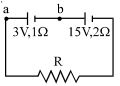
- 4Two batteries one of the $\mathrm{emf}$ $3\,V$, internal resistance $1$ ohm and the other of $\mathrm{emf}$ $15\, V$, internal resistance $2$ $\mathrm{ohm}$ are connected in series with a resistance $R$ as shown. If the potential difference between $a$ and $b$ is zero the resistance of $R$ in $\mathrm{ohm}$ isView Solution
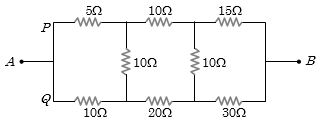
- 5In the arrangement of resistances shown below, the effective resistance between points $A$ and $B$ is ............... $\Omega$View Solution
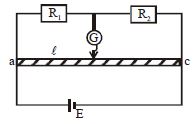
- 6Fig. shows rough sketch of meter bridge. $(G)$ deflects zero at length $\ell \, cm$. Now $R_1$ and $R_2$ are interchanged then balancing length increases by $25\, cm$. Find $R_1/R_2$View Solution
- 7A heating element has a resistance of $100\,\Omega $ at room temperature. When it is connected to a supply of $220\,V,$ a steady current of $2\,A$ passes in it and temperature is $500\,^oC$ more than room temperature. What is the temperature coefficient resistance of the heating element?View Solution
- 8A metal wire of resistance $3\,\Omega $ is elongated to make a uniform wire of double its previous length. The new wire is now bent and the ends joined to make a circle. If two points on this circle make an angle $60^o$ at the centre, the equivalent resistance between these two points will beView Solution
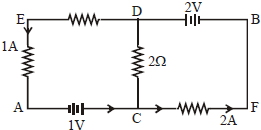
- 9In the circuit, given in the figure currents in different branches and value of one resistor are shown. Then potential at point $B$ with respect to the point $A$ is$.......V$View Solution
- 10Three resistances $4\,\Omega $ each of are connected in the form of an equilateral triangle. The effective resistance between two corners isView Solution