Question
(a) Define conduction current. Explain the necessity of displacement current and derive to formula for it.
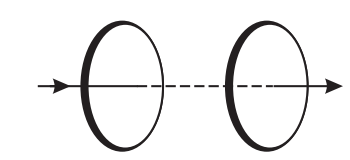
(b) In adjoining figure a capacitor is shown which is made by placing two circular plates (each of 12 cm radius) at a distance 5.0 cm apart.
Image
The capacitor is being charged by an external source which is not shown in the figure. The charging current is 0.15 A. Calculate:
(i) capacitance of the capacitor and rate of change of potential difference between its plates.
(ii) the displacement current between the plates.
(iii) Is the Kirchhoff's first law related to electric current obeyed on each plate.
Answer

(a) Conduction current : The actual electric current flowing through connecting wires of electrical circuit is called conduction current.
Necessity of displacement current : The concept of displacement current arised due to following points:
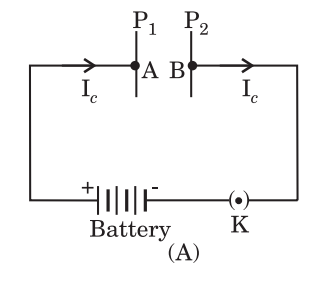
(1) Apparent Violation of Kirchhoff's First Law i.e., Law of Junction : In Fig. (A) a circuit containing a capacitor, a battery and a key is shown which is set for charging the capacitor. When the key is closed a conduction current $l _c$ flows through the connecting wires and the capacitor beings to be charged.
Image
The current decreases as the charge on the capacitor grows. When the capacitor is fully charged to the voltage equal to that of the battery, the current vanishes. There is no current between the plates $P _1$ and $P _2$ of the capacitor during charging. Therefore if Kirchhoff's first law is applied on the junction points A and B of the plates separately then its violation is seen because a current $I _c$ is observed going towards A but no current is observed going away from it and similarly no current is seen going towards B but a current $I _c$ is going away from it. But Kirchhoff's first law is in accordance with the law of conservation of charge which is always true. Therefore, necessarily there is some current between the plates of the capacitor which is going away from A towards B but it is not being seen. This current is the displacement current whose concept was given by Maxwell.
(2) Violation of Ampere's Circuital Law : A magnetic field is produced around a current carrying conductor. Ampere's circuital law gives the qualitative relationship between the current and the magnetic field. According to this law the line integral of the magnetic field $\overrightarrow{ B }$ around any closed loop is $\mu_0$ times the net current I the treading through the area enclosed by the loop.
i.e. $\quad \int \vec{B} \cdot \overrightarrow{d l}=\mu_0 I$
When this law was applied by Maxwell on the conduction current during the charging of a capacitor the violation of this law was seen as explained below :
Image
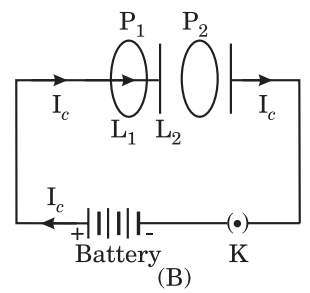
In Fig. (B) a set up for charging a capacitor is shown in which $I_2$ is the conduction current through the connecting wires, which is varying with time. There will be magnetic field around this current. During charging of the capacitor there is no conduction current between the plates $P _1$ and $P _2$ of the capacitor.
Let us now consider a plane circular look $L _1$ just before the plate $P _1$ and another closed loop $L _2$ parallel to $L _1$ and lying between the plates of the capacitor. Current threading through the area enclosed by the loop $L _1$ is the conduction current $I _c$ and no current is threading through the area of loop $L _2$ because there is no conduction current between the plates of the capacitor. Now, on applying Ampere's circuital law for these loops, we have.
$\text { For loop } L_1: \int_{L_1} \overrightarrow{B} \cdot \overrightarrow{d l}=\mu_0 I_c $ ...(1)
$\text { For loop } L_2: \int_{L_2} \overrightarrow{B} \cdot \overrightarrow{d l}=\mu_0 \times 0=0$ ...(2)
If loops $L_1$ and $L_2$ are very close to each other then it is expected that
$\int_{L_1} \overrightarrow{B} \cdot \overrightarrow{dl}=\int_{L_2} \overrightarrow{B} \cdot \overrightarrow{dl}$
But it is obvious from equations (1) and (2) that $\int_{ L _1} \overrightarrow{B} \cdot \overrightarrow{d l} \neq \int_{ L _2} \overrightarrow{B} \cdot \overrightarrow{d l}$. Hence there is violation of Ampere's circuital law during charging of a capacitor. Therefore, in order to give the correct form to Ampere's circuital law. Maxwell gave the concept of displacement current.
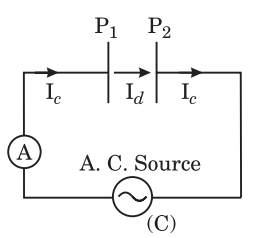
(3) Flow of Alternating Current through the Capacitor : In Fig. (C) a parallel plate capacitor connected to an a.c. source through a hot wire ammeter is shown where there is air in between the plates of the capacitor. The a.c. ammeter shows a deflection showing the flow of current through the circuit. But the circuit seems to be broken between the plates of the capacitor due to air gap between them.
Image
Now the question arises whether any current can flow through a broken circuit? In order to understand this, Maxwell introduced to concept of displacement current (Id) to flow between the plates of the capacitor through air.
Such a current is produced due to changing electric field between the plates of the parallel plate capacitor during its charging or due to the applied a.c. source its plates.
Expression for displacement current : During the charging process of a parallel plate capacitor the electric charge on the plates is time varying. Let at any instant 't' the electric charge on the plates of the capacitor be q and let the intensity of electric field between the plate be E. is given by the following formula :
$E =\frac{q}{\varepsilon_0 A}$,
where A = area of each of the plates of the capacitor.
Since $q$ is time varying i.e., it is the function or 't', therefore the time rate of change of electric field between the plates is given by :
$\frac{d E }{d t}=\frac{d}{d t}\left[\frac{q}{\varepsilon_0 A}\right]=\frac{1}{\varepsilon_0 A}\left(\frac{d q}{d t}\right)$
$\frac{d q}{d t}=\varepsilon_0 A\left(\frac{d E }{d t}\right)$
Because the time rate of change of electric charge is called electric current and $\left[\varepsilon_0 A \cdot \frac{d E }{d t}\right]$has the dimension of current, the quantity $\varepsilon_0 A\left(\frac{d E }{d t}\right)$ is called displacement current is denoted by Id.
Displacement Current
$I _d=\varepsilon_0 A \left(\frac{ d E }{ d t }\right)$ ...(1)
This expression for Id can be expressed as follows also :
$I _d=\varepsilon_0 A\left(\frac{d E }{d t}\right) \Rightarrow I _d=\varepsilon_0 \frac{d}{d t}( E . A )$
But E.A. = Electric flux through the plates of the capacitor $=\Phi_{ E }$
Displacement Current
$I _d=\varepsilon_0\left(\frac{ d \Phi_{ E }}{ d t }\right)$ ...(2)
Thus displacement current is a current in a region where change of electric flux takes place due to change in electric flux intensity. It is produced by the displace-ment and distance of electrons caused by changing electric field, hence the name displacement current. In magnitude it is equal to conduction current.
(b) Given: Radius of the circular plate r = 12 cm = 0.12 m and distance between the plates d = 5 cm = 0.05 m and conduction current Ic = 0.15 A.
(i) Capcitance of the Capacitor :
$C =\frac{\varepsilon_0 A}{d}=\frac{\varepsilon_0\left(\pi r^2\right)}{d}$
$=\left[\frac{\left(8.85 \times 10^{-12}\right)(3.14)(0.12)}{0.05}\right] F$
$=8.0 \times 10^{-12} F=8.0 pF$
Charge at any instant on the capacitor :
$Q = CV = V = Q / C$
∴ Rate of change of potential difference between the plates:
$\frac{d V}{d t}=\frac{d}{d t}\left(\frac{ Q }{ C }\right)=\frac{1}{ C }\left(\frac{d Q }{d t}\right) ;$ But $\frac{d Q }{d t}=$ Conduction
current $I _c$
i.e., charging current = 0.15 Ampere
$\therefore \frac{d V}{d t}=\frac{1}{ C } \times I _c=\left(\frac{1}{8.0 \times 10^{-12}}\right)(0.15) \frac{ V }{ s }$
$=1.87 \times 10^{-10}$ volt second $^{-1}$
(ii) Displacement Current = Conduction Current = 0.15 A.
(iii) Yes Kirchhoff's first law is obeyed at each of the plates because electric current coming towards each plate to equal to the current going away from the plate since conduction current $I _c=$ displacement current $I _d$, i.e., in fig. (C) at $P _1$ we have $I _d= I _c$ and at $P _2$ we have $I _c=$ $I _d$.

Need a full question paper?

Generate a complete, print-ready paper with questions like this in minutes — across 16+ boards, with answer keys.

Start Generating Free

Similar questions

Differentiate between self induction and mutual induction with examples.
A point charge causes an electric flux of $–1.0 \times 10^3 Nm^2 /C$ to pass through a spherical Gaussian surface of $10.0 \ cm$ radius centred on the charge.
  1. If the radius of the Gaussian surface were doubled, how much flux would pass through the surface?
  2. What is the value of the point charge?
A beam of white light is incident normally on a plane surface absorbing 70% of the light and reflecting the rest. If the incident beam carries 10W of power, find the force exerted by it on the surface.
Suppose the $19\Omega$ resistor of the previous problem is disconnected. Find the current through $P_2Q_2$ in the two situations:
  1. Both the wires move towards right.
  2. If $P_1Q_1$ moves towards left but $P_2Q_2$ moves towards right.
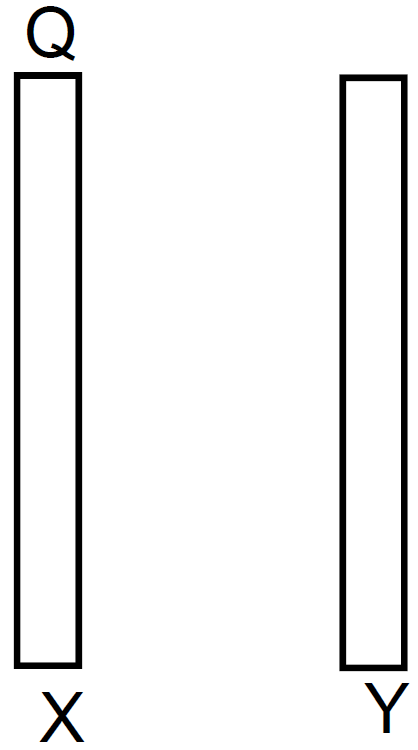
Two conducting plates X and Y, each having large surface area A (on one side), are placed parallel to each other as shown in figure. The plate X is given a charge Q whereas the other is neutral. Find:
  1. The surface charge density at the inner surface of the plate X.
  2. The electric field at a point to the left of the plates.
  3. The electric field at a point in between the plates.
  4. The electric field at a point to the right of the plates.
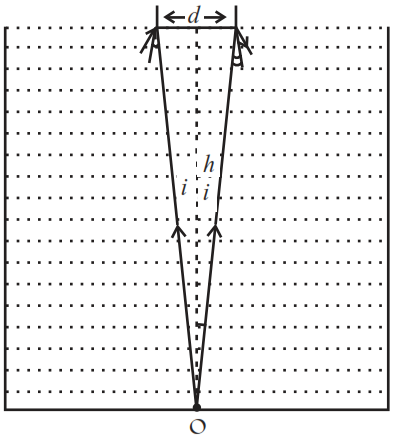
A jar of height $h$ is filled with a transparent liquid of refractive index $\mu ($Fig$)$. At the centre of the jar on the bottom surface is a dot. Find the minimum diameter of a disc, such that when placed on the top surface symmetrically about the centre, the dot is invisible.
The neutron separation energy is defined as the energy required to remove a neutron from the nucleus. Obtain the neutron separation energies of the nuclei $^{41}_{20}\text{Ca }$ and ${27}_{13}\text{Al}$ from the following data:
$\text{m}(^{40}_{20}\text{Ca})=39.962591\text{ u}$
$\text{m}(^{41}_{20}\text{Ca})=40.962278\text{ u}$
$\text{m}(^{26}_{13}\text{Al})=25.986895\text{ u}$
$\text{m}(^{27}_{13}\text{Al})=26.981514\text{ u}$
Define the capacitance of a capacitor. Obtain an expression for the capacitance of a parallel plate capacitor. And explain on what factors the does capacitance depend?
What is an ammeter? How can we convert any galvanometer into an ammeter of given range? Explain.###Describe briefly that how and when any galvanometer is converted into an ammeter?
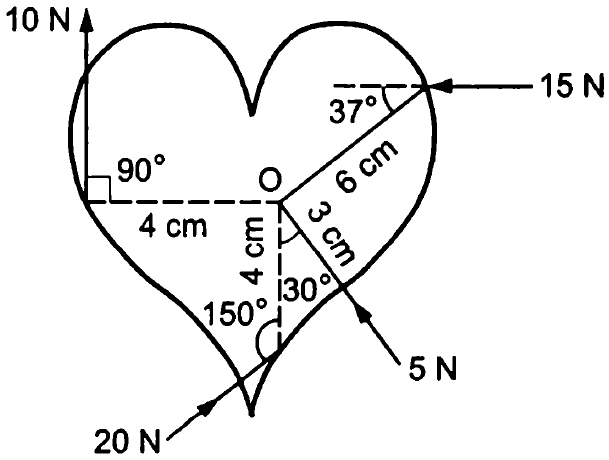
Calculate the total torque acting on the body shown in figure about the point $O$.