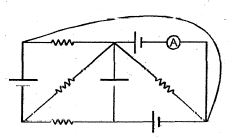
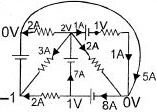
In the circuit diagram shown, each battery is ideal having an e.m.f. of $1\ volt$. Each resistor has a resistance of $1\Omega $ Ammotor$(A)$ has a resistance of $1\Omega $ Find the reading of the ammeter and the total thermal power produced in the circuit
Diffcult


Download our appand get started for free
Experience the future of education. Simply download our apps or reach out to us for more information. Let's shape the future of learning together!No signup needed.*
Similar Questions
- 1$3$ identical bulbs are connected in series and these together dissipate a power $P$. If now the bulbs are connected in parallel, then the power dissipated will beView Solution
- 2A cell of e.m.f. $E$ is connected with an external resistance $R$, then p.d. across cell is $V$. The internal resistance of cell will beView Solution
- 3View SolutionIn meter bridge or Wheatstone bridge for measurement of resistance, the known and the unknown resistances are interchanged. The error so removed is
- 4A cell whose e.m.f. is $2\, V$ and internal resistance is $0.1\,\Omega $, is connected with a resistance of $3.9\,\Omega $. The voltage across the cell terminal will be ................ $V$View Solution
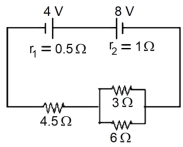
- 5In the circuit diagram shown in figure given below, the current flowing through resistance $3\, \Omega$ is $\frac{ x }{3}\,A$. The value of $x$ is $...........$View Solution
- 6View SolutionThe mechanism of the heat produced in a conductor when an electric current flows through it, can be explained on the basis of
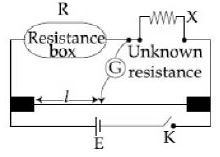
- 7In a meter bridge experiment, the circuit diagram and the corresponding observation table are shown in figureView Solution
$Sl$. $No$. $R\, (\Omega )$ $l\, (cm)$ $1$. $1000$ $60$ $2$. $100$ $13$ $3$. $10$ $1.5$ $4$. $1$ $1.0$ Which of the readings is inconsistent ?
- 8Two wires $A$ and $B$ made of same material and having their lengths in the ratio $6 : 1$ are connected in series. The potential difference across the wires are $3\,V$ and $2\,V$ respectively. If $r_A$ and $r_B$ are the radii of $A$ and $B$ respectively, then $\frac{{{r_B}}}{{{r_A}}}$ isView Solution
- 9A steady current $I$ is set up in a wire whose cross-sectional area decreases in the direction of the flow of the current. Then, as we examine the narrowing region,View Solution
- 10Resistors of $1$, $2$, $ohm$ are connected in the form of a triangle. If a $1.5\, volt$ cell of negligible internal resistance is connected across $3\, ohm$ resistor, the current flowing through this resistance will be ................ $amp$View Solution