A mass $m =100\, gms$ is attached at the end of a light spring which oscillates on a frictionless horizontal table with an amplitude equal to $0.16$ metre and time period equal to $2 \,sec$. Initially the mass is released from rest at $t = 0$ and displacement $x = - 0.16$ metre. The expression for the displacement of the mass at any time $t$ is
Medium


Download our appand get started for free
Experience the future of education. Simply download our apps or reach out to us for more information. Let's shape the future of learning together!No signup needed.*
Similar Questions
- 1$2$ particles $p$ and $q$ describe $SHM$ of same amplitude $a$ and same frequency $f$ along straight line, the maximum distance between the two particle $a\sqrt 2 $ . The initial phase difference between particle isView Solution
- 2Three simple harmonic motions of equal amplitudes $A$ and equal time periods in the same direction combine. The phase of the second motion is $60^o$ ahead of the first and the phase of the third motion is $60^o$ ahead of the second. Find the amplitude of the resultant motionView Solution
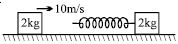
- 3A $2\, Kg$ block moving with $10\, m/s$ strikes a spring of constant $\pi ^2 N/m$ attached to $2\, Kg$ block at rest kept on a smooth floor. The time for which rear moving block remain in contact with spring will be ... $\sec$View Solution
- 4The length of a spring is $l$ and its force constant is $k$. When a weight $W$ is suspended from it, its length increases by $x$. If the spring is cut into two equal parts and put in parallel and the same weight $W$ is suspended from them, then the extension will beView Solution
- 5A body executes simple harmonic motion. The potential energy $(P.E.)$, the kinetic energy $(K.E.)$ and total energy $(T.E.)$ are measured as a function of displacement $x$. Which of the following statements is trueView Solution
- 6Which one of the following equations of motion represents simple harmonic motion ?View Solution
Where $k,k_0,k_1$ and $a$ are all positive
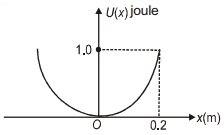
- 7A particle of mass $4 \,kg$ moves simple harmonically such that its $P E(U)$ varies with position $x$, as shown. The period of oscillations is ............View Solution
- 8A spring of force constant $k$ is cut into lengths of ratio $1:2:3$ . They are connected in series and the new force constant is $k'$ . Then they are connected in parallel and force constant is $k''$ . Then $k':k''$ isView Solution
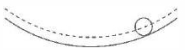
- 9A ball is rolling without slipping in a spherical shallow bowl (radius $R$ ) as shown in the figure and is executing simple harmonic motion. If the radius of the ball is doubled, then the time period of oscillationView Solution
- 10View SolutionA simple pendulum is set into vibrations. The bob of the pendulum comes to rest after some time due to