A particle executes $S.H.M.$ with a period of $6$ second and amplitude of $3\, cm$. Its maximum speed in $cm/sec$ is
AIIMS 1982, Easy
Download our app for free and get started
(b) ${v_{\max }} = a\omega = a\frac{{2\pi }}{T} = 3 \times \frac{{2\pi }}{6} = \pi \,cm/s$

Download our appand get started for free
Experience the future of education. Simply download our apps or reach out to us for more information. Let's shape the future of learning together!No signup needed.*
Similar Questions
- 1A body executes sample harmonic motion under the action of a force $F_1$ with a time period $(4 / 5)\ sec$. If the force is changed to $F_ 2$ it executes $SHM$ with time period $(3 / 5)\ sec$. If both the forces $F_1$ and $F_2$ act simultaneously in the same direction on the body, it's time period (in $second$) isView Solution
- 2When a mass $m$ is attached to a spring it oscillates with period $4 \,s$. When an additional mass of $2 \,kg$ is attached to a spring, time period increases by $1 \,s$. The value of $m$ is ........... $kg$View Solution
- 3The total energy of the body executing $S.H.M.$ is $E$. Then the kinetic energy when the displacement is half of the amplitude, isView Solution
- 4The displacement of a particle is represented by the equation $y = sin^3\,\,\,\omega t$ . The motion isView Solution
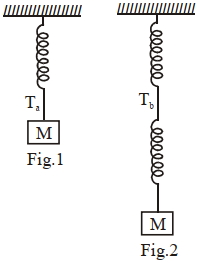
- 5Consider two identical springs each of spring constant $k$ and negligible mass compared to the mass $M$ as shown. Fig. $1$ shows one of them and Fig. $2$ shows their series combination. The ratios of time period of oscillation of the two $SHM$ is $\frac{ T _{ b }}{ T _{ a }}=\sqrt{ x },$ where value of $x$ isView Solution
(Round off to the Nearest Integer)
- 6A pendulum with time period of $1\, s$ is losing energy due to damping. At certain time its energy is $45\, J$. If after completing $15\,oscillations$ , its energy has become $15\, J$, its damping constant (in $s^{-1}$ ) isView Solution
- 7A particle in $SHM $ is described by the displacement equation $x(t) = A\cos (\omega t + \theta ).$ If the initial $(t = 0)$ position of the particle is $1 \,cm$ and its initial velocity is $\pi $cm/s, what is its amplitude? The angular frequency of the particle is $\pi {s^{ - 1}}$View Solution
- 8A mass $\mathrm{m}$ is suspended from a spring of negligible mass and the system oscillates with a frequency $f_1$. The frequency of oscillations if a mass $9 \mathrm{~m}$ is suspended from the same spring is $f_2$. The value of $\frac{f_1}{f_{.2}}$ is_____________.View Solution
- 9A pendulum clock that keeps correct time on the earth is taken to the moon it will run (it is given that $g_{Moon} = g_{Earth}/6$ )View Solution
- 10A mass $M$ is suspended from a spring of negligible mass. The spring is pulled a little and then released so that the mass executes $S.H.M.$ of time period $T$. If the mass is increased by m, the time period becomes $5T/3$. Then the ratio of $m/M$ isView Solution