A particle is vibrating in a simple harmonic motion with an amplitude of $4\, cm.$ At what displacement from the equilibrium position, is its energy half potential and half kinetic
Medium


Download our appand get started for free
Experience the future of education. Simply download our apps or reach out to us for more information. Let's shape the future of learning together!No signup needed.*
Similar Questions
- 1When an oscillator completes $100$ oscillations its amplitude reduced to $\frac{1}{3}$ of initial value. What will be its amplitude, when it completes $200$ oscillations?View Solution
- 2View SolutionWhich of the diagrams shown in figure represents variation of total mechanical energy of a pendulum oscillating in water as function of time ?
- 3A particle executes simple harmonic motion with a frequency $f$. The frequency with which its kinetic energy oscillates isView Solution
- 4The length of simple pendulum is increased by $44\%$. The percentage increase in its time period will be ..... $\%$View Solution
- 5A pendulum suspended from the ceiling of a train has a period $T$, when the train is at rest. When the train is accelerating with a uniform acceleration a, the period of oscillation willView Solution
- 6A force of $6.4\, N$ stretches a vertical spring by $0.1 \,m$. The mass that must be suspended from the spring so that it oscillates with a period of $\left( {\frac{\pi }{4}} \right)sec$. is ... $kg$View Solution
- 7A mass $M$ is suspended from a spring of negligible mass. The spring is pulled a little and then released so that the mass executes $S.H.M.$ of time period $T$. If the mass is increased by m, the time period becomes $5T/3$. Then the ratio of $m/M$ isView Solution
- 8The amplitude of a particle executing $S.H.M.$ with frequency of $60 \,Hz$ is $0.01 \,m$. The maximum value of the acceleration of the particle isView Solution
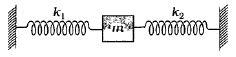
- 9Two springs, of force constants $k_1$ and $k_2$ are connected to a mass $m$ as shown. The frequency of oscillation of the mass is $f$ If both $k_1$ and $k_2$ are made four times their original values, the frequency of oscillation becomesView Solution
- 10One-forth length of a spring of force constant $K$ is cut away. The force constant of the remaining spring will beView Solution