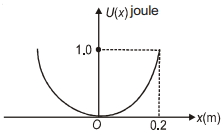
A particle of mass $4 \,kg$ moves simple harmonically such that its $P E(U)$ varies with position $x$, as shown. The period of oscillations is ............
Medium
Download our app for free and get started
(d)
Mass $=4 \,kg$
Maximum $P.E.$ $=\frac{1}{2} k A^2$
$1=\frac{1}{2} \times k \times(0.2)^2$
$\frac{2}{0.04}=k$
$k=50 \,N / m$
$T=2 \pi \sqrt{\frac{m}{k}}$
$T=2 \pi \sqrt{\frac{4}{50}}$
$=\frac{2 \sqrt{2} \pi}{5} \,s$

Download our appand get started for free
Experience the future of education. Simply download our apps or reach out to us for more information. Let's shape the future of learning together!No signup needed.*
Similar Questions
- 1The time period of a simple pendulum is $2\, sec$. If its length is increased $4$ times, then its period becomes ..... $\sec$View Solution
- 2The amplitude of a damped oscillator decreases to $0.9$ times its original magnitude in $5\ s$. In another $10\ s$ it will decrease to $\alpha $ times its original magnitude, where $\alpha $ equalsView Solution
- 3In $SHM,$ acceleration versus displacement (from mean position) graph :View Solution
- 4A spring mass system preforms $S.H.M.$ If the mass is doubled keeping amplitude same, then the total energy of $S.H.M.$ will become :View Solution
- 5The motion of a mass on a spring, with spring constant ${K}$ is as shown in figure. The equation of motion is given by $x(t)= A sin \omega t+ Bcos\omega t$ with $\omega=\sqrt{\frac{K}{m}}$ Suppose that at time $t=0$, the position of mass is $x(0)$ and velocity $v(0)$, then its displacement can also be represented as $x(t)=C \cos (\omega t-\phi)$, where $C$ and $\phi$ areView Solution
- 6If a Second's pendulum is moved to a planet where acceleration due to gravity is $4$ times, the length of the second's pendulum on the planet should be made .......... timesView Solution
- 7View SolutionThe total energy of a particle executing simple harmonic motion is
- 8A mass $m$ attached to a spring oscillates every $2\, sec$. If the mass is increased by $2 \,kg$, then time-period increases by $1\, sec$. The initial mass is ..... $kg$View Solution
- 9Two pendulums differ in lengths by $22\,cm$ . They oscillate at the same place such that one of them makes $15\,oscillations$ and the other makes $18\,oscillations$ during the same time. The lengths (in $cm$ ) of the pendulums areView Solution
- 10The displacement of a particle varies according to the relation $x = 4(cos\pi t + sin\pi t).$ The amplitude of the particle isView Solution