A particle performs $SHM$ about $x = 0$ such that at $t = 0$ it is at $x = 0$ and moving towards positive extreme. The time taken by it to go from $x = 0$ to $x = \frac{A}{2}$ is ..... times the time taken to go from $x = \frac{A}{2}$ to $A$. The most suitable option for the blank space is
Diffcult
Download our app for free and get started
Time for $x=0$ to $x=\frac{A}{2}$ is
$\frac{\mathrm{A}}{2}=\mathrm{A} \sin \omega \mathrm{t}_{1} \quad \Rightarrow \omega \mathrm{t}_{1}=\frac{\pi}{6} \Rightarrow \mathrm{t}_{1}=\frac{\pi}{6 \omega}$
$\Rightarrow t_{1}=\frac{T}{12}$
and from $x=\frac{A}{2}$ to $x=A$ is
$\mathrm{t}_{2}=\frac{\mathrm{T}}{4}-\frac{\mathrm{T}}{12}=\frac{\mathrm{T}}{6} \Rightarrow \frac{\mathrm{t}_{1}}{\mathrm{t}_{2}}=\frac{1}{2}$

Download our appand get started for free
Experience the future of education. Simply download our apps or reach out to us for more information. Let's shape the future of learning together!No signup needed.*
Similar Questions
- 1The potential energy of a particle of mass $0.1\,kg,$ moving along $x-$ axis, is given by $U = 5x(x-4)\,J$ where $x$ is in metres. It can be concluded thatView Solution
- 2The amplitude of the vibrating particle due to superposition of two $SHMs,$View Solution
$y_1 = \sin \left( {\omega t + \frac{\pi }{3}} \right)$ and $y_2 = \sin \omega t$ is :
- 3Two particle executing $S.H.M.$ of same amplitude of $20 \,cm$ with same period along the same line about same equilibrium position. The maximum distance between the two is $20 \,cm$. Their phase difference in radian is equal toView Solution
- 4View SolutionA particle is moving in a circle with uniform speed. Its motion is
- 5A block with mass $M$ is connected by a massless spring with stiffiess constant $k$ to a rigid wall and moves without friction on a horizontal surface. The block oscillates with small amplitude $A$ about an equilibrium position $x_0$. Consider two cases: ($i$) when the block is at $x_0$; and ($ii$) when the block is at $x=x_0+A$. In both the cases, a perticle with mass $m$ is placed on the mass $M$ ?View Solution
($A$) The amplitude of oscillation in the first case changes by a factor of $\sqrt{\frac{M}{m+M}}$, whereas in the second case it remains unchanged
($B$) The final time period of oscillation in both the cases is same
($C$) The total energy decreases in both the cases
($D$) The instantaneous speed at $x_0$ of the combined masses decreases in both the cases
- 6The displacement equations of two interfering waves are given byView Solution
$y_1 =10 \sin \left(\omega t+\frac{\pi}{3}\right) cm$
$y_2 =5[\sin (\omega t)+\sqrt{3} \cos \omega t] \;cm$ respectively.
The amplitude of the resultant wave is $.............cm$.
- 7Two masses $m_1$ and $m_2$ are suspended together by a massless spring of constant $K$. When the masses are in equilibrium, $m_1$ is removed without disturbing the system. The amplitude of oscillations isView Solution

- 8The displacements of two particles executing $S.H.M.$ on the same line are given. as $y_1=a \sin \left(\frac{\pi}{2} t+\phi\right)$ and $y_2=b \sin \left(\frac{2 \pi}{3} t+\phi\right)$. The phase difference between them at $t=1 \,s$ is .........View Solution
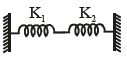
- 9View SolutionThe effective spring constant of two spring system as shown in figure will be
- 10A uniform rod of length $2.0 \,m$ is suspended through an end and is set into oscillation with small amplitude under gravity. The time period of oscillation is approximately .... $\sec$View Solution