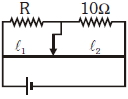
A resistance wire connected in the left gap of a meter bridge balances a $10\, \Omega$ resistance in the right gap at a point which divides the bridge wire in the ratio $3: 2 .$ If the length of the resistance wire is $1.5 m ,$ then the length of $1\, \Omega$ of the resistance wire is $....... \times 10^{-2}\;m$
NEET 2020, Medium


Download our appand get started for free
Experience the future of education. Simply download our apps or reach out to us for more information. Let's shape the future of learning together!No signup needed.*
Similar Questions
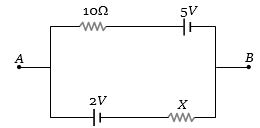
- 1If ${V_{AB}} = 4\,V$ in the given figure, then resistance $X$ will be .............. $\Omega$View Solution
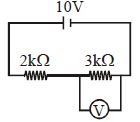
- 2In the circuit shown in figure, the resistance of voltmeter is $6\, k\Omega $. The voltmeter reading will be ................. $\mathrm{V}$View Solution
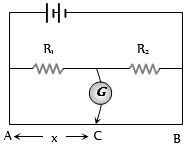
- 3In the shown arrangement of the experiment of the meter bridge if $AC$ corresponding to null deflection of galvanometer is $x$, what would be its value if the radius of the wire $AB$ is doubledView Solution
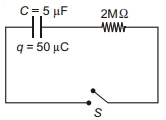
- 4The following circuit consist of a $5 \,\mu F$ capacitor, having charge $50 \,\mu C$ as shown. The switch is closed at $t=0$. The value of current in $2 \,M \Omega$ resistor at $t=0$ is ........... $\mu A$View Solution
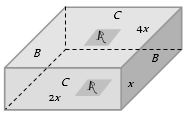
- 5In figure shows a rectangular block with dimensions $x,\, 2x$ and $4x$. Electrical contacts can be made to the block between opposite pairs of faces (for example, between the faces labelled $A-A, B-B$ and $C-C$). Between which two faces would the maximum electrical resistance be obtained ($A-A$ : Top and bottom faces, $B-B$ : Left and right faces, $C-C$ : Front and rear faces)View Solution
- 6Two batteries of different $e.m.f.'s$ and internal resistance connected in series with each other and with an external load resistor. The current is $3.0 \,A$. When the polarity of one battery is reversed, the current becomes $1.0 \,A$. The ratio of the $e.m.f.'s$ of the two batteries is ............View Solution
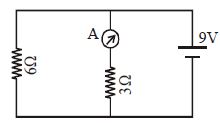
- 7In the figure shown, if the internal resistance of the battery is $1\, ohm$, the reading of the ammeter will be ............... $A$View Solution
- 8In the box shown current $i$ enters at $H$ and leaves at $C$. If $i_{AB} = \frac{{\text{i}}}{6}$ , $i_{DC} = \frac{{\text{2i}}}{3}$ ,$i_{HA} = \frac{{\text{i}}}{2} , i_{GF} = \frac{{\text{i}}}{6} , i_{HE} = \frac{{\text{i}}}{6}$ , choose the branch in which current is zeroView Solution

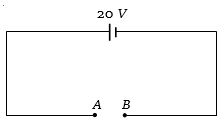
- 9In the shown circuit, what is the potential difference across $A$ and $B$ ......... $V$View Solution
- 10A cell of negligible resistance and $e.m.f.$ $2$ $volts$ is connected to series combination of $2$, $3$ and $5\, ohm$. The potential difference in volts between the terminals of $3\, ohm$ resistance will beView Solution