A resistor dissipates $192\, {J}$ of energy in $1\, {s}$ when a current of $4\, {A}$ is passed through it. Now, when the current is doubled, the amount of thermal energy dissipated in $5 \,{s}$ in $.....\,J.$
JEE MAIN 2021, Medium
Download our app for free and get started
${E}={i}^{2} {Rt}$
$192=16({R})(1)$
${R}=12\, \Omega$
${E}^{1}=(8)^{2}(12)(5)$
$=3840\, {J}$

Download our appand get started for free
Experience the future of education. Simply download our apps or reach out to us for more information. Let's shape the future of learning together!No signup needed.*
Similar Questions
- 1When $5\ V$ potential difference is applied across a wire of length $0.1\ m$, the drift speed of electrons is $2.5 \times 10^{-4}$ $ms^{-1}$ . If the electron density in the wire is $8 \times 10^{28}$ $m^{-3}$ the resistivity of the material is close toView Solution
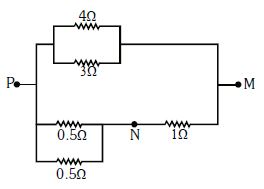
- 2In the circuit shown, the current through the $4\,\Omega $ resistor is $1\, amp$ when the points $P$ and $M$ are connected to a d.c. voltage source. The potential difference between the points $M$ and $N$ is ............... $volt$View Solution
- 3Copper and silicon is cooled from $300\; K$ to $60\; K$, the specific resistanceView Solution
- 4When a potential difference $V$ is applied across a wire of resistance $R$, it dissipates energy at a rate $W$. If the wire is cut into two halves and these halves are connected mutually parallel across the same supply, the same supply, the energy dissipation rate will become:View Solution
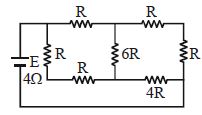
- 5A battery of internal resistance $4\, ohm$ is connected to the network of resistance as hown. In the order that the maximum power can be delivered to the network, the value of $R$ in ohm should be :-View Solution
- 6The electric resistance of a certain wire of iron is $R$. If its length and radius are both doubled, thenView Solution
- 7The emf of a battery is $2\, V$ and its internal resistance is $0.5 \,\Omega$. The maximum power which it can deliver to any external circuit will be ............. $watt$View Solution
- 8This question contains statement$-1$ and statement$-2$. Of the four choices given after the statements, choose the one that best describes the two statements.View Solution
statement$-1$ : The temperature dependence of resistance is usually given as $R=R_{0}(1+\alpha \Delta t)$. The resistance of a wire changes from $100\; \Omega$ to $150\; \Omega$ when its temperature is increased from $27^{\circ} C$ to $227^{\circ} C$. This implies that $\alpha=2.5$ $\times 10^{-3} /{ }^{\circ} C$
statement$-2\;: R=R_{0}(1+\alpha \Delta t)$ is valid only when the change in the temperature $\Delta T$ is small and $\Delta R=\left(R-R_{0}\right) < < R_{0}$
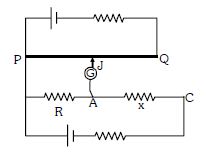
- 9Circuit for the measurement of resistance by potentiometer is shown. The galvanometer is first connected at point $A$ and zero deflection is observed at length $P J = 10\ cm$ . In second case it is connected at point $C$ and zero deflection is observed at a length $30\ cm$ from $P$ . Then the unknown resistance $X$ isView Solution
- 10There is a current of $1.344\, amp$ in a copper wire whose area of cross-section normal to the length of the wire is $1\,m{m^2}$. If the number of free electrons per $c{m^3}$ is $8.4 \times {10^{22}}$, then the drift velocity would beView Solution