A rod of mass $m$ and length $l$ is suspended from ceiling with two string of length $l$ as shown. When the rod is given a small push in the plane of page and released time period is $T_1$ and when the rod is given a push perpendicular to plane time period of oscillation is $T_2$ . The ratio $\frac{{T_1^2}}{{T_2^2}}$ is
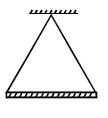
Diffcult
Download our app for free and get started
Physical pendulum
$\mathrm{T}_{1}=2 \pi \sqrt{\frac{\mathrm{I}}{\mathrm{mgd}}}=2 \pi \sqrt{\frac{\frac{\mathrm{m} \ell^{2}}{12}+\mathrm{m}\left(\frac{(\sqrt{3})}{2}\right)^{2}}{\mathrm{mg}\left(\frac{\ell \sqrt{3}}{2}\right)}}$
$\mathrm{T}_{2}=2 \pi \sqrt{\frac{\mathrm{d}}{\mathrm{g}}}=2 \pi \sqrt{\frac{\frac{\ell \sqrt{3}}{2}}{\frac{2}{\mathrm{g}}}}$
$\left(\frac{T_{1}}{T_{2}}\right)^{2}=\frac{10}{9}$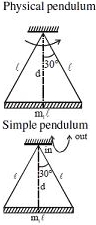

Download our appand get started for free
Experience the future of education. Simply download our apps or reach out to us for more information. Let's shape the future of learning together!No signup needed.*
Similar Questions
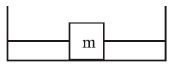
- 1A block of mass $m$ is having two similar rubber ribbons attached to it as shown in the figure. The force constant of each rubber ribbon is $K$ and surface is frictionless. The block is displaced from mean position by $x\,cm$ and released. At the mean position the ribbons are underformed. Vibration period isView Solution
- 2Two pendulums have time periods $T$ and $\frac{{5T}}{4}.$They start $S.H.M.$ at the same time from the mean position. What will be the phase difference between them after the bigger pendulum has complete one oscillation ..... $^o$View Solution
- 3Two particles are executing simple harmonic motion of the same amplitude $A$ and frequency $\omega$ along the $x-$axis. Their mean position is separated by distance $X_0(X_0 > A).$ If the maximum separation between them is $(X_0 + A)$, the phase difference between their motion is:View Solution
- 4A body oscillates with $S.H.M.$ according to the equation $x=(5.0 \,m ) \cos \left[\left(2 \pi \,rad s ^{-1}\right) t+\pi / 4\right]$ At $t=1.5 \,s$, its acceleration is ....... $m / s ^2$View Solution
- 5A body executes simple harmonic motion. The potential energy $(P.E.)$, the kinetic energy $(K.E.)$ and total energy $(T.E.)$ are measured as a function of displacement $x$. Which of the following statements is trueView Solution
- 6$Assertion :$ In $SHM$, acceleration is always directed towards the mean position.View Solution
$Reason :$ In $SHM$, the body has to stop momentary at the extreme position and move back to mean position. - 7A particle moves with simple harmonic motion in a straight line. In first $\tau \,s,$ after starting from rest it travels a distance $a,$ and in next $\tau \,s$ it travels $2a,$ in same direction, thenView Solution
- 8The equation of motion of a particle of mass $1\,g$ is $\frac{{{d^2}x}}{{d{t^2}}} + {\pi ^2}x = 0$ where $x$ is displacement (in $m$ ) from mean position. The frequency of oscillation is .... $s$ (in $Hz$ )View Solution
- 9The period of oscillation of a mass $M$ suspended from a spring of negligible mass is $T$. If along with it another mass $M$ is also suspended, the period of oscillation will now beView Solution
- 10Two equations of two $S.H.M.$ are $y = a\sin \,(\omega \,t - \alpha )$ and $y = b\cos (\omega \,t - \alpha )$. The phase difference between the two is .... $^o$View Solution