MCQ
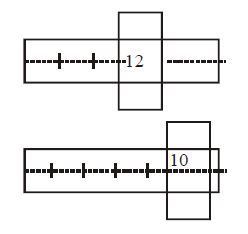
A screw gauge has some zero error but its value is unknown. We have two identical rods. When the first rod is inserted in the screw, the state of the instrument is shown by diagram $(I).$ When both the rods are inserted together in series then the state is shown by the diagram $(II).$ What is the zero error of the instrument ? .......... $mm$

$1\,M.S.D. = 100\, C.S.D. = 1\, mm $ 
  • A
    $-0.16 $
  • B
    $+0.16$
  • $+0.14$
  • D
    $-0.14$

Answer

Correct option: C.
$+0.14$
c
$\ell+x=2.12$

$2 \ell+x=4.10$

$x=0.14$

Need a full question paper?

Generate a complete, print-ready paper with questions like this in minutes — across 16+ boards, with answer keys.

Start Generating Free

Similar questions

The elastic limit for a gas
A particle of mass $M$ originally at rest is subjected to a force whose direction is constant but magnitude varies with time according to the relation

$F=F_{0}\left(1-\left(\frac{t-T}{T}\right)^{2}\right)$

Where $F_{0}$ and $T$ are constants. The force acts only for the time internal $2 T$. The velocity $v$ of the particle after time $2 {T}$ is -

An object is projected horizontally with speed $\frac{1}{2} \sqrt{\frac{G M}{R}}$, from a point at height $3 R$ [where $R$ is radius and $M$ is mass of earth, then object will] 
According to Joule's law of heating, heat produced $H = {I^2}\,Rt$, where I is current, $R$ is resistance and $t$ is time. If the errors in the measurement of $I, R$ and t are $3\%, 4\% $ and $6\% $ respectively then error in the measurement of $H$ is
The density of a cube is measured by measuring its mass and the length of its sides. If the maximum errors in the measurement of mass and length are 3% and 2% respectively, then the maximum error in the measurement of density is:
A vector $\vec{A}$ points towards North and vector $\vec{B}$ points upwards then $\vec{A} \times \vec{B}$ points towards ...........
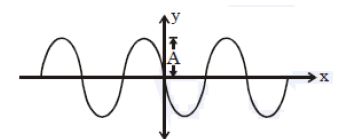
A progressive wave travelling along the positive $x-$ direction is represented by $y(x, t) = A\,sin\,\left( {kx - \omega t + \phi } \right)$. Its snapshot at $t = 0$ is given in the figure For this wave, the phase $\phi $ is
A spherical liquid drop of radius $R$ is divided into eight equal droplets. If surface tension is $T$, then the work done in this process will be
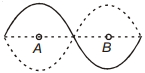
In the standing wave shown, particles at the positions $A$ and $B$ have a phase difference of
Ship $A$ is sailing towards north -east with velocity $\vec v = 30\,\hat i + 50\hat j\,km/hr$ where $\hat i$ points east and $\hat j$ , north. Ship $B$ is at a distance of $80\, km$ east and $150\, km$ north of Ship $A$ and is sailing towards west at $10\, km/hr$. $A$ will be at minimum distance from $B$ is.........$hrs$