Question
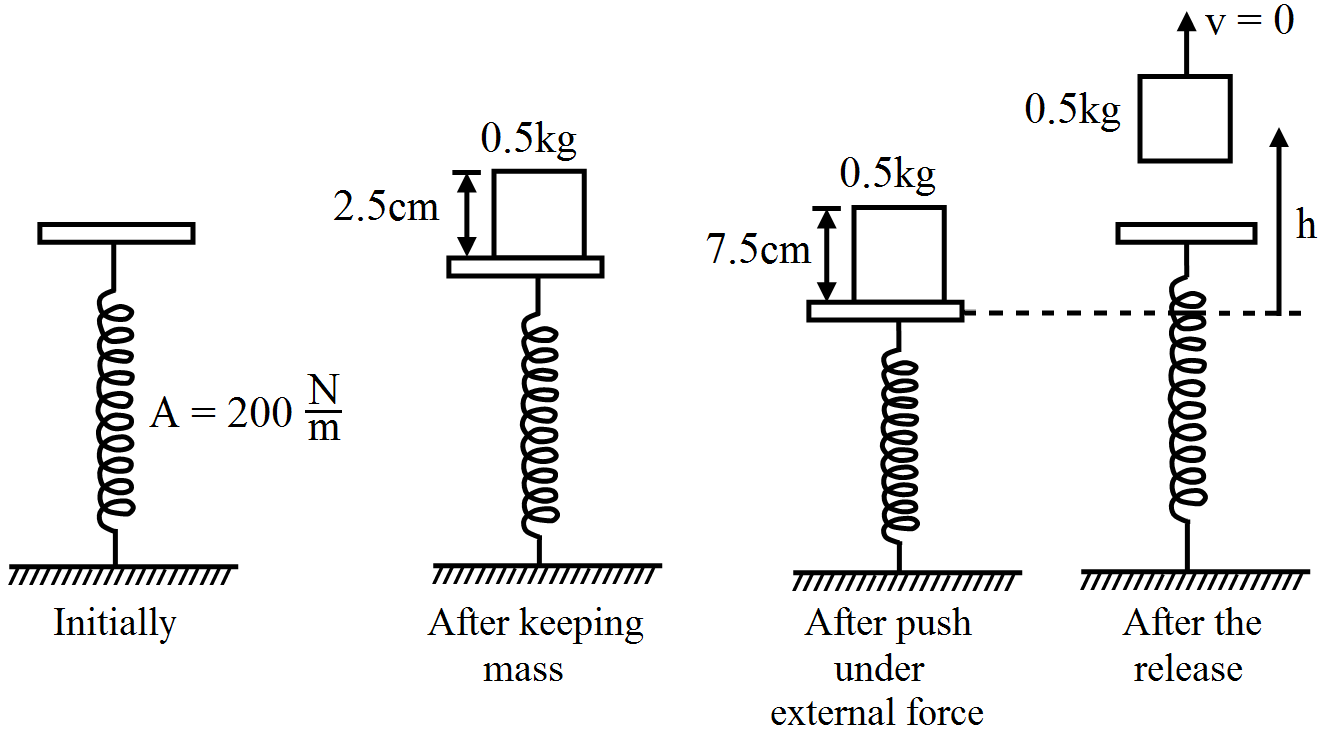
A vertical spring with constant $200N/ m$ has a light platform on its top. When a $500g$ mass is kept on the platform spring compresses $2.5cm$. Mass is now pushed down $7.50cm$ further and released. How far above later position will the mass fly? $(g = 10ms^{-2})$.
Answer

When the external force is removed after the push, the mass gets detached when spring obtain its natural length and say, mass m rises h height from the pushed position.

Loss in Potential energy of spring = Gain in gravitational potential energy. $\frac{1}{2}\text{k}[\text{x}^2]=\text{mgh}$ $\frac{1}{2}\times200[0.1]^2$ = 0.5 × 10 × h 1 = 5h ⇒ h = 0.2m

Need a full question paper?

Generate a complete, print-ready paper with questions like this in minutes — across 16+ boards, with answer keys.

Start Generating Free

Similar questions

Find the temperature at which the speed of sound in oxygen will be the same as that in nitrogen at 20°C. Given that molar masses of oxygen and nitrogen are 32 and 28 respectively. Both gases are assumed to be ideal.
Work done by a force is given by $\text{W}=\vec{\text{F}.}\vec{\text{S}}\text{ Where}\vec{\text{ F}}$ is the force and $\vec{\text{S}}$is the displacement. Show that:
  1. Work done is also equal to change in K.E.
  2. Work done is also equal to change in potential energy using this expression.
The noise level in a class-room in absence of the teacher is 50dB when 50 students are present. Assuming that on the average each student outputs same sound energy per second, what will be the noise level if the number of students is increased to 100?
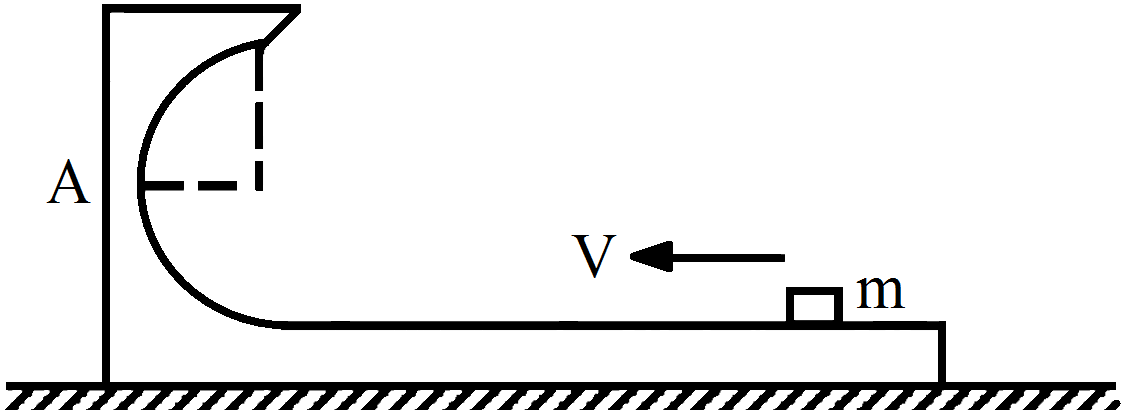
Figure shows a small block of mass m which is started with a speed v on the horizontal part of the bigger block of mass M placed on a horizontal floor. The curved part of the surface shown is semicircular. All the surfaces are frictionless. Find the speed of the bigger block when the smaller block reaches the point A of the surface.
A spring of force constant k has a mass M suspended from it. If the spring is cut into two halves, and the same mass is attached to one of the pieces, what will be the frequencies of oscillation of the mass?
A man capable of swimming with a velocity u in still water, wants to cross a river of width 'd' flowing with a velocity v. Find the angle in which he should be directed to reach at the exactly opposite point? To cross by the shortest time, in which direction, he should swim? What is the value of shortest time?
By suddenly compressing a gas at a temperature of 300 K, its pressure is made 8 times the initial pressure. Calculate the temperature increase due to compression $(\gamma=1.5)$.
On what parameter does the $\lambda ($mean free path$)$ depends?
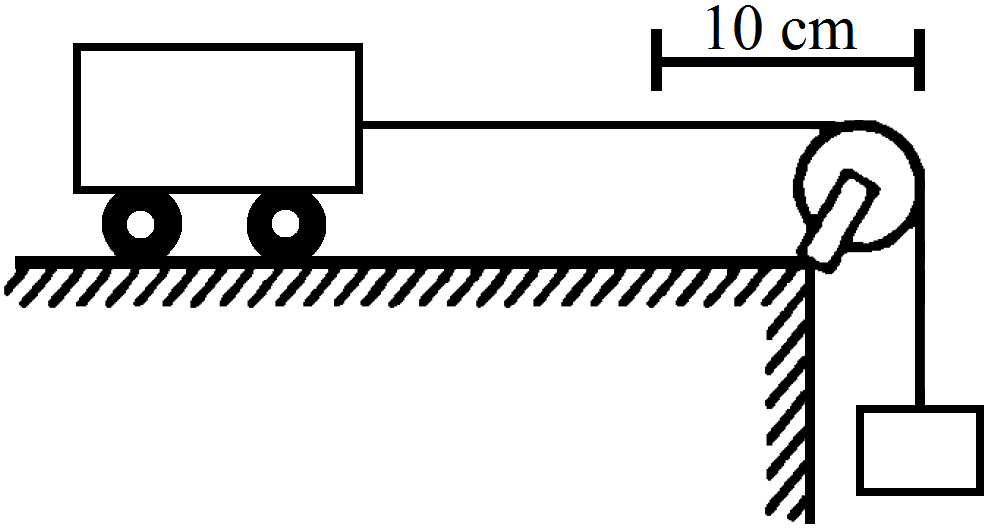
A heavy string is tied at one end to a movable support and to a light thread at the other end as shown in figure, The thread goes over a fixed pulley and supports a weight to produce a tension. The lowest frequency with which the heavy string resonates is 120Hz. If the movable support is pushed to the right by 10cm so that the joint is placed on the pulley, what will be the minimum frequency at which the heavy string can resonate?
Two waves, travelling in the same direction through the same region, have equal frequencies, wavelengths and amplitudes. If the amplitude of each wave is 4mm and the phase difference between the waves is 90°, what is the resultant amplitude?