Question
  1. Although nitrogen and chlorine have nearly same electronegativity yet nitrogen forms hydrogen bonding while chlorine does not. Why?
  2. What happens when $F_2$ reacts with water?
  3. Write the name of the gas evolved when $Ca_3P_2$ is dissolved in water.
  4. Write the formula of a noble gas species which is isostructural with $IBr_2$.
  5. Complete the equation:
$[Fe(H_2O)_6]^{2+}$ + NO $\longrightarrow$

Answer

  1. Size of Nitrogen is smaller than Chlorine.
  2. $2F_2 + 2H_2O$ $\longrightarrow$ $4HF + O_2 / HF$ and $O_2$ are produced.
  3. $PH_3$/Phosphine.
  4. $XeF_2$​​​​​​​
  5. $[Fe(H_2O)_6]^{2+} + NO^-$$\longrightarrow$ $[Fe(H_2O)_5(NO)]^{2+} + H_2O$

Need a full question paper?

Generate a complete, print-ready paper with questions like this in minutes — across 16+ boards, with answer keys.

Start Generating Free

Similar questions

Answer the following question: Write mechanism of the reaction of HI with methoxymethane.
  1. Differentiate between molarity and molality for a solution. How does a change in temperature influence their values?
  2. Calculate the freezing point of an aqueous solution containing $10.50\ g$ of $MgBr_2$ in $200\ g$ of water. (Molar mass of $MgBr_2 = 184 g$)
$(K_f$ for water $= 1.86\ K\ kg\ mol^{–1})$
Describe the methods of studying various first order reactions with examples.
How are carboxylic acids prepared from the following compounds? Explain with examples:
(a) Primary alcohol
(b) Acyl halide
(c) Acid anhydride
(d) Grignard reagent
(e) Alkyl benzene.
  1. Account for the following:
  1. Ozone is thermodynamically unstable.
  2. Solid $PCl_5$ is ionic in nature.
  3. Fluorine forms only one oxoacid HOF.
  1. Draw the structure of
  1. $BrF_{5.}$​​​​​​​
  2. $XeF_{4.}​​​​​​​$​​​​​​​
Magnetic properties of coordination compounds. Explain in detail.
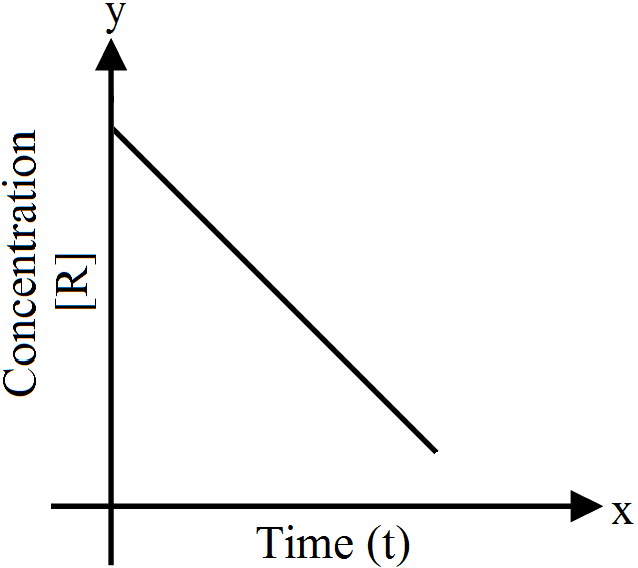
Consider the reaction $\text{R}\xrightarrow{\ \ \text{k}\ \ } \text{P}.$ The change in concentration of $R$ with time is shown in the following plot:
  1. Predict the order of the reaction.
  2. Derive the expression for the time required for the completion of the reaction.
  3. What does the slope of the above line indicate?
Define the following modes of expressing the concentration of a solution. Which of these modes are independent of temperature and why?
  1. w/w (mass percentage)
  2. V/V (volume percentage)
  3. w/V (mass by volume percentage)
  4. ppm. (parts per million)
  5. x (mole fraction)
  6. M (Molarity)
  7. m (Molality)
$(i).$ Illustrate the following reactions giving suitable example in each case:
$a.$ Ammonolysis
$b.$ Coupling reaction
$c.$ Acetylation of amines
$(ii).$ Describe Hinsberg method for the identification of primary, secondary and tertiary amines. Also, write the chemical equations of the reactions involved.
Give reasons for each of the following:
  1. $\text{SiF}_{6}^{2-}$ is known but $\text{SiCl}_{6}^{2-}$ is not known.
  2. Sulphur in vapour state exhibits paramagnetic behaviour.
  3. $PbO_2$ is a stronger oxidizing agent than $SnO_2$.
  4. $H_3PO_2$ acts as a monobasic acid.
  5. Bond dissociation energy of $F_2$​​​​​​​ is less than that of $Cl_2$.