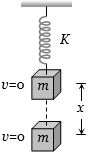
An ideal spring with spring-constant $K$ is hung from the ceiling and a block of mass $M$ is attached to its lower end. The mass is released with the spring initially unstretched. Then the maximum extension in the spring is
IIT 2002, Medium


Download our appand get started for free
Experience the future of education. Simply download our apps or reach out to us for more information. Let's shape the future of learning together!No signup needed.*
Similar Questions
- 1Two particles are executing $SHM$ in a straight line. Amplitude $'A'$ and time period $'T'$ of both the particles are equal. At time $t = 0$ one particle is at displacement $x_1 = +A$ and other at ${x_2} = \frac{{ - A}}{2}$ and they are approaching towards each other. Time after which they will cross each other isView Solution
- 2For a simple pendulum the graph between $L$ and $T$ will be.View Solution
- 3A mass $m$ is vertically suspended from a spring of negligible mass; the system oscillates with a frequency $n$. What will be the frequency of the system if a mass $4 m$ is suspended from the same springView Solution
- 4If the length of a pendulum is made $9$ times and mass of the bob is made $4$ times then the value of time period becomesView Solution
- 5If a spring has time period $T$, and is cut into $n$ equal parts, then the time period of each part will beView Solution
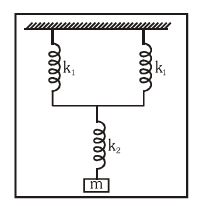
- 6View SolutionThe total spring constant of the system as shown in the figure will be
- 7A spring executes $SHM$ with mass of $10\,kg$ attached to it. The force constant of spring is $10\,N/m$.If at any instant its velocity is $40\,cm/sec$, the displacement will be .... $m$ (where amplitude is $0.5\,m$)View Solution
- 8View SolutionA simple pendulum is taken from the equator to the pole. Its period
- 9View SolutionA pendulum is swinging in an elevator. Its period will be greatest when the elevator is
- 10In a simple pendulum, the period of oscillation $T$ is related to length of the pendulum $l$ asView Solution