MCQ
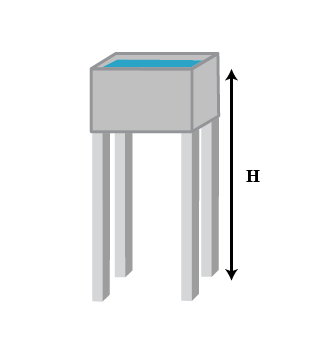
An overhead tank having some water possesses .......... energy.
  • A
    Kinetic
  • B
    Potential
  • C
    Thermal
  • D
    Electrical

Answer

  1. Potential

Explanation:

We know that Potential energy is the energy possessed by a body by the virtue of its position.

$\therefore$ An overhead tank having some water possesses Potential energy, as it is at a height.
Need a full question paper?

Generate a complete, print-ready paper with questions like this in minutes — across 16+ boards, with answer keys.
Start Generating Free

Similar questions

A particle is kept at rest at a distance Re (earth's radius) above the earth's surface. The minimum speed with which it should be projected so that it does not return is (mass of earth = Me)
The velocity $v$ of a particle as a function of its position $(x)$ is expressed as $v=\sqrt{c_1-c_2 x}$, where $c_1$ and $c_2$ are positive constants. The acceleration of the particle is
Inside a uniform spherical shell:
  1. The gravitational potential is zero.
  2. The gravitational field is zero.
  3. The gravitational potential is same everywhere.
  4. The gravitational field is same everywhere.
Projection of vector $\vec A$ on $\vec B$ is
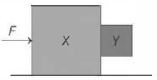
Consider the system shown below. A horizontal force $F$ is applied to a block $X$ of mass $8 \,kg$, such that the block $Y$ of mass $2 \,kg$ adjacent to it does not slip downwards under gravity. There is no friction between the horizontal plane and the base of the block $X$. The coefficient of friction between the surfaces of blocks $X$ and $Y$ is $0.5$. The minimum value of $F$ is ............ $N$ (take, acceleration due to gravity to be $10 \,ms ^{-2}$ )
The work done in increasing the length of a metre long wire of cross-sectional area ........ $J.$ $1\,mm^2$ through $1\,mm$ will be $(Y = 2 \times 10^{11}\,Nm^{-2})$
A particle is projected with speed $u$ at angle $\theta$ with horizontal from ground. If it is at same height from ground at time $t_1$ and $t_2$, then its average velocity in time interval $t_1$ to $t_2$ is .........
Two rods of different materials having coefficient of thermal expansion $\alpha_1,\alpha_2$ and Young's modulus Y1, Y2, respectively are fixed between two rigid massive walls. The rods are heated such that they undergo the same increase in temperature. There is no bending of the rods. If $\alpha_1:\alpha_2=2:3,$ the thermal stresses developed in the two rods are equal provided Y1 : Y2 is equal to:
A body constrained to move along $y-$ axis is subjected to a constant force $\vec F = -\hat i + 2\hat j+ 3\hat k\,\,N$ . The work done by this force in moving the body a distance of $4\, m$ along $y-$ axis is ............... $\mathrm{J}$
If a particle of mass $m$ is moving in a horizontal circle of radius $r$ with a centripetal force $( - k/{r^2})$, the total energy is