$Assertion :$ The time-period of pendulum, on a satellite orbiting the earth is infinity.
$Reason :$ Time-period of a pendulum is inversely proportional to $\sqrt g$
$Reason :$ Time-period of a pendulum is inversely proportional to $\sqrt g$
AIIMS 2002, Easy
Download our app for free and get started
Time period of pendulum in a satellite is infinity. It means it may not oscillate as apparent value of $g$ is zero. So, time period being $\propto \sqrt {\frac{1}{g}} \propto \sqrt \infty $

Download our appand get started for free
Experience the future of education. Simply download our apps or reach out to us for more information. Let's shape the future of learning together!No signup needed.*
Similar Questions
- 1View SolutionThe velocity of simple pendulum is maximum at
- 2$Assertion :$ In simple harmonic motion, the motion is to and fro and periodicView Solution
$Reason :$ Velocity of the particle $(v) = \omega \sqrt {k^2 - x^2}$ (where $x$ is the displacement). - 3View SolutionA particle of mass m is hanging vertically by an ideal spring of force constant K. If the mass is made to oscillate vertically, its total energy is
- 4View SolutionA tunnel has been dug through the centre of the earth and a ball is released in it. It will reach the other end of the tunnel after
- 5A particle performs $S.H.M.$ of amplitude $A$ with angular frequency $\omega$ along a straight line. Whenit is at a distance $\frac{{\sqrt 3 }}{2}$ $A$ from mean position, its kinetic energy gets increased by an amount $\frac{1}{2}m{\omega ^2}{A^2}$ due to an impulsive force. Then its new amplitude becomesView Solution
- 6The frequency of oscillation of a mass $m$ suspended by a spring is $v_1$. If length of spring is cut to one third then the same mass oscillates with frequency $v_2$, thenView Solution
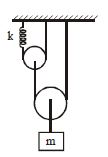
- 7What is the period of small oscillations of the block of mass $m$ if the springs are ideal and pulleys are massless ?View Solution
- 8View SolutionTwo particles are oscillating along two close parallel straight lines side by side, with the same frequency and amplitudes. They pass each other, moving in opposite directions when their displacement is half of the amplitude. The mean positions of the two particles lie on a straight line perpendicular to the paths of the two particles. The phase difference is
- 9A body is executing simple harmonic motion with frequency $'n',$ the frequency of its potential energy is :View Solution
- 10Two, spring $P$ and $Q$ of force constants $k_p$ and ${k_Q}\left( {{k_Q} = \frac{{{k_p}}}{2}} \right)$ are stretched by applying forces of equal magnitude. If the energy stored in $Q$ is $E$, then the energy stored in $P$ isView Solution