Assume that a tunnel is dug along a chord of the earth, at a perpendicular distance $( R / 2)$ from the earth's centre, where $'R'$ is the radius of the Earth. The wall of the tunnel is frictionless. If a particle is released in this tunnel, it will execute a simple harmonic motion with a time period
JEE MAIN 2021, Diffcult
Download our app for free and get started
Force along the tunnel
$F =-\left(\frac{ GMmr }{ R ^{3}}\right) \cos \theta$
$F =-\frac{ gm }{ R } x \left(\frac{ GM }{ R ^{2}}= g , r \cos \theta= x \right)$
$a=-\frac{g}{R} x$
$\omega^{2}=\frac{g}{R} \quad T=2 \pi \sqrt{\frac{R}{g}}$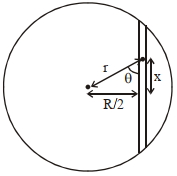

Download our appand get started for free
Experience the future of education. Simply download our apps or reach out to us for more information. Let's shape the future of learning together!No signup needed.*
Similar Questions
- 1Two $SHM$ are represented by equations, $y_1 = 6\cos \left( {6\pi t + \frac{\pi }{6}} \right)\,,{y_2} = 3\left( {\sqrt 3 \sin 3\pi t + \cos 3\pi t} \right)$View Solution
- 2The potential energy of a particle $\left(U_x\right)$ executing $S.H.M$. is given byView Solution
- 3View SolutionWhich of the diagrams shown in figure represents variation of total mechanical energy of a pendulum oscillating in water as function of time ?
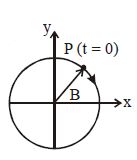
- 4Figure shows the circular motion of a particle. The radius of the circle, the period, sense of revolution and the initial position are indicated on the figure. The simple harmonic motion of the $x-$ projection of the radius vector of the rotating particle $P$ isView Solution
- 5The displacement of an object attached to a spring and executing simple harmonic motion is given by $ x= 2 \times 10^{-9}$ $ cos$ $\;\pi t\left( m \right)$ .The time at which the maximum speed first occurs isView Solution
- 6Two springs of constant ${k_1}$and ${k_2}$are joined in series. The effective spring constant of the combination is given byView Solution
- 7A simple harmonic oscillator has a period of $0.01 \,sec$ and an amplitude of $0.2\, m$. The magnitude of the velocity in $m{\sec ^{ - 1}}$ at the centre of oscillation isView Solution
- 8The vertical extension in a light spring by a weight of $1\, kg$ suspended from the wire is $9.8\, cm$. The period of oscillationView Solution
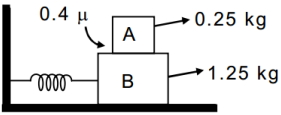
- 9Maximum amplitude(in $cm$) of $SHM$ so block A will not slip on block $B , K =100 N / m$View Solution
- 10The $ P.E.$ of a particle executing $SHM$ at a distance $x$ from its equilibrium position isView Solution