At room temperature $\left(27^{\circ} \mathrm{C}\right)$, the resistance of a heating element is $50 \Omega$. The temperature coefficient of the material is $2.4 \times 10^{-4}{ }^{\circ} \mathrm{C}^1$. The temperature of the element, when its resistance is $62 \Omega$, is $\qquad$ ${ }^{\circ} \mathrm{C}$.
JEE MAIN 2024, Diffcult
Download our app for free and get started
$mathrm{R}=\mathrm{R}_0(1+\alpha \Delta \mathrm{T})$
$62=50\left\lfloor 1+2.4 \times 10^{-4} \Delta \mathrm{T}\right\rfloor$
$\Delta \mathrm{T}=1000^{\circ} \mathrm{C}$
$\Rightarrow \mathrm{T}-27^{\circ}=1000^{\circ} \mathrm{C}$
$\mathrm{T}=1027^{\circ} \mathrm{C}$

Download our appand get started for free
Experience the future of education. Simply download our apps or reach out to us for more information. Let's shape the future of learning together!No signup needed.*
Similar Questions
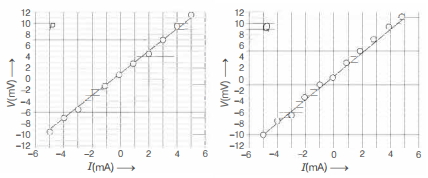
- 1Two students $P$ and $Q$ perform an experiment to verify Ohm's law for a conductor with resistance $R$. They use a current source and a voltmeter with least counts of $0.1 mA$ and $0.1 \,mV$, respectively. The plots of the variation of voltage drop $V$ across $R$ with current $I$ for both are shown below. The statement which is most likely to be correct?View Solution
- 2A resistor ${R_1}$ dissipates the power $P$ when connected to a certain generator. If the resistor ${R_2}$ is put in series with ${R_1}$, the power dissipated by ${R_1}$View Solution
- 3An electric toaster has resistance of $60\ \Omega$ at room temperature $\left(27^{\circ} \mathrm{C}\right)$. The toaster is connected to a $220 \mathrm{~V}$ supply. If the current flowing through it reaches $2.75 \mathrm{~A}$, the temperature attained by toaster is around : (if $\alpha=2 \times 10^{-4} /{ }^{\circ} \mathrm{C}$ )View Solution
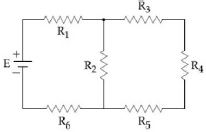
- 4In the figure shown, what is the current (in Ampere) drawn from the battery ? You are given $R_1 = 15\,\Omega $$,R _2 = 10\,\Omega ,$$ R_3 = 20\,\Omega ,$$ R_4 = 5\,\Omega ,$$R_5 = 25\,\Omega ,$$R_6 = 30\,\Omega , $$E = 15\,V$View Solution
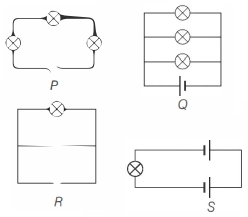
- 5Following figures show different combinations of identical bulb$(s)$ connected to identical battery$(ies)$. Which option is correct regarding the total power dissipated in the circuit?View Solution
- 6Two cells of same emf but different internal resistances $I_{1}$ and $I_{2}$ are connected in series with a resistance $R$. The value of resistance $R$, for which the potential difference across second cell is zero, isView Solution
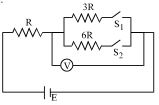
- 7In the circuit shown in figure reading of voltmeter is $V_1$ when only $S_1$ is closed, reading of voltmeter is $V_2$ when only $S_2$ is closed. The reading of voltmeter is $V_3$ when both $S_1$ and $S_2$ are closed thenView Solution
- 8The effective resistance between $A$ and $B$ of the shown network, where resistance of each resistor is $R$ , isView Solution
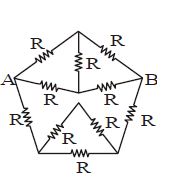
- 9Three resistors having resistances $\mathrm{r}_{1}, \mathrm{r}_{2}$ and $\mathrm{r}_{3}$ are connected as shown in the given circuit. The ratio $\frac{i_{3}}{i_{1}}$ of currents in terms of resistances used in the circuit is :View Solution
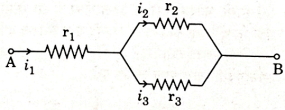
- 10The thermo $e.m.f.$ of a thermo-couple is $25\,\mu V{/^o}C$ at room temperature. A galvanometer of $40\, ohm$ resistance, capable of detecting current as low as ${10^{ - 5}}\,A,$ is connected with the thermocouple. The smallest temperature difference that can be detected by this system is ................ $^oC$View Solution