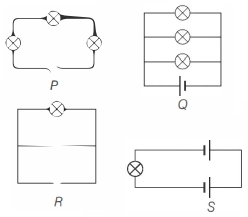
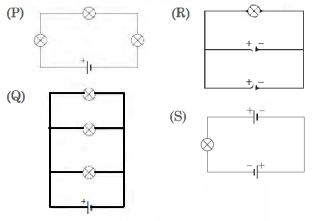
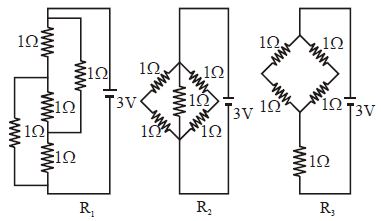
Following figures show different combinations of identical bulb$(s)$ connected to identical battery$(ies)$. Which option is correct regarding the total power dissipated in the circuit?
KVPY 2012, Diffcult


Download our appand get started for free
Experience the future of education. Simply download our apps or reach out to us for more information. Let's shape the future of learning together!No signup needed.*
Similar Questions
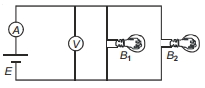
- 1Two identical bulbs are connected in parallel across an ideal source of emf $E$. The ammeter $A$ and voltmeter $V$ are ideal. If bulb $B_2$ gets fused, thenView Solution
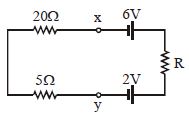
- 2The current flowing in the given circuit is $0.1\,A$ . The potential difference between the points $X$ and $Y$ is ................ $\mathrm{V}$View Solution
- 3What amount of heat will be generated in a coil of resistance $R$ due to a charge $q$ passing through it if the current in the coil decreases to zero uniformly during a time interval $\Delta t$View Solution
- 4Figure shows three resistor configurations $R_1,R_2$ and $R_3$ connected to $3\,V$ battery. If the power dissipated by the configuration $R_1, R_2$ and $R_3$ is $P_1, P_2$ and $P_3$ , respectively thenView Solution
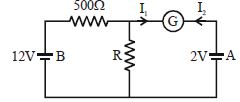
- 5In the adjoining circuit, the galvanometer $G$ shows zero deflection. If the batteries $A$ and $B$ have negligible internal resistance, the value of the resistor $R$ will be .............. $\Omega$View Solution
- 6Three light bulbs of $40\, W$, $60\, W$ and $100\, W$ are connected in series with $220\, V$ source. Which one of the bulbs will glow brightest ............ $W$View Solution
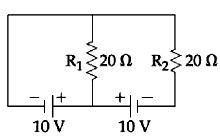
- 7In the given circuit the cells have zero internal resistance. The currents (in Amperes) passing through resistance $R_1$ and $R_2$ respectively, areView Solution
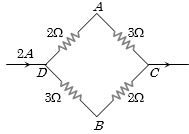
- 8A current of $2\,A$ flows in a system of conductors as shown. The potential difference $({V_A} - {V_B})$ will be ............ $V$View Solution
- 9View SolutionThe potentiometer is best for measuring voltage, as
- 10Three resistors each of $4\,\Omega $ are connected together to form a network. The equivalent resistance of the network cannot be ............ $\Omega$View Solution