Question
Can you add three unit vectors to get a unit vector? Does your answer change if two unit vectors are along the coordinate axes?

Answer

Of course we can add three unit vectors to give a unit vector. An example of this is i, i, -i even If any two unit vectors are along the axes the third vector can so be aligned so that they give a vector of unit magnitude. I will give you an example: i, j, –i.

Need a full question paper?

Generate a complete, print-ready paper with questions like this in minutes — across 16+ boards, with answer keys.
Start Generating Free

Similar questions

If an object far away from a convex mirror moves towards the mirror, the image also moves. Does it move faster, slower or at the same speed as compared to the object?
How to use Kirchhoff's rules ?
A short bar magnet placed with its axis at $30^{\circ}$ with a uniform external magnetic field of 0.25 T experiences a torque of magnitude equal to $4.5 \times 10^{-2} J$. What is the magnitude of magnetic moment of the magnet?
How resistivity of material depends on its temperature. Write its empirical formula.
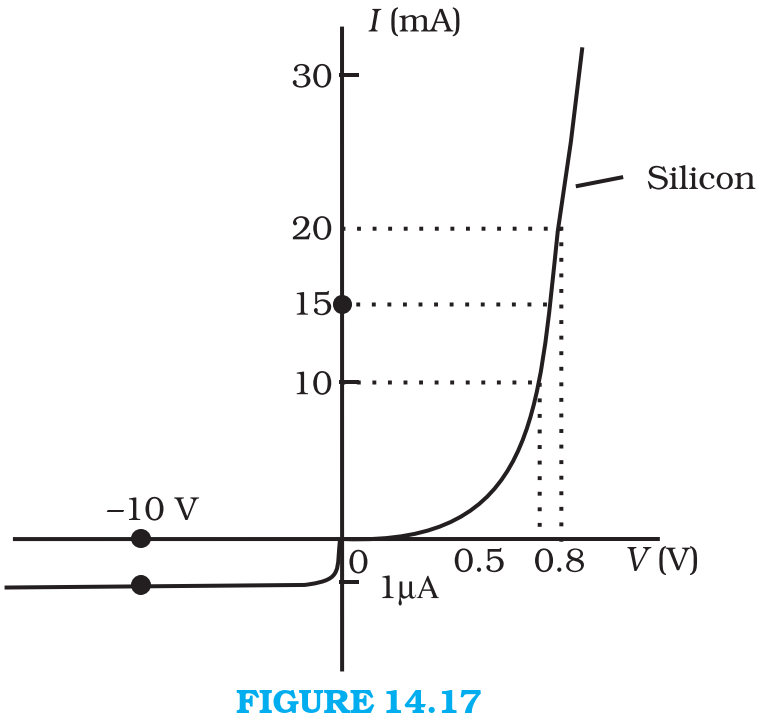
The $V-I$ characteristic of a silicon diode is shown in the Fig. 14.17. Calculate the resistance of the diode at (a) $I_D=15 mA$ and (b) $V_D=-10 V$.
Image
Answer the following:
a. Magnetic field lines can be entirely confined within the core of a toroid, but not within a straight solenoid. Why?
b. Does a bar magnet exert a torque on itself due to its own field? Justify your answer.
c. When an electron revolves around a nucleus, obtain the expression for the magnetic moment associated with it.
Define equipotential surface.
Four $ 12~\Omega $ resistances are connected in parallel. There such combinations are connected in series. What will be the total resistance ?
A point charge is taken from a point A to a point B in an electric field. Does the work done by the electric field depend on the path of the charge?
Consider a 10cm long portion of a straight wire carrying a current of 10A placed in a magnetic field of 0.1T making an angle of 53° with the wire. What magnetic force does the wire experience?