Question
Column I (Structure Before seed formation)Column II (Structure After seed formation)
A. Funiculusi. Hilum
B. Scar of Ovuleii. Tegmen
C. Zygoteiii. Testa
D. Inner Integumentiv. Stalk of Seed
 v. Embryo

Answer

A-iv, B-i, C-v D-ii

Need a full question paper?

Generate a complete, print-ready paper with questions like this in minutes — across 16+ boards, with answer keys.
Start Generating Free

Similar questions

Read the following and answer any four questions from (i) to (v) given below:
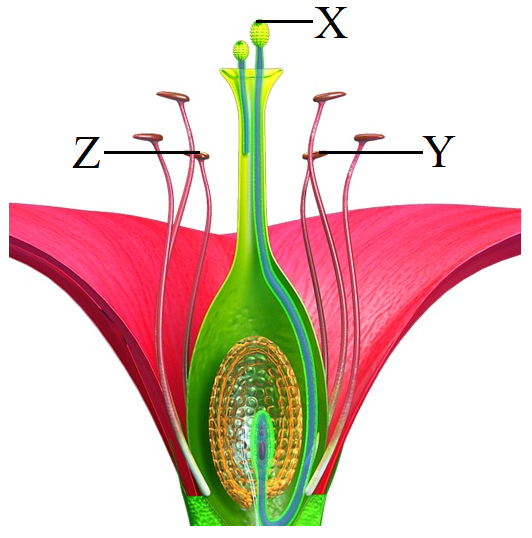
Cross pollination is the transfer of pollen grains from the anther of a one flower to the stigma of a genetically different flower. It is performed with the help of an external agency which may be abiotic (e.g., wind, water) or biotic (e.g., insects, birds, bats, snails). The diagram shows the carpel of an insect pollinated flower.
  1. What is the most likely reason for non germination of pollen grain Z?
  1. Pollen grains X and Y were brought to the stigma earlier, therefore, their germination inhibited the germination of pollen grain Z.
  2. Pollen grain Z was brought to the flower by wind, while pollen grains X and Y were brought to the flower by insect.
  3. Pollen grain Z lacks protrusions that allow it to adhere properly onto the stigma surface.
  4. Pollen grain Z comes from a flower of an incompatible species.
  1. Which of the following best describes the function of the pollen tube?
  1. It acts as a conduit to transport male gametes from the anther to the ovule.
  2. It acts as a conduit to transport male gametes from the stigma to the ovule.
  3. It contains key nutrients that serve to nourish the newly-formed zygote.
  4. It digests the tissues of the stigma, style, and ovary.
  1. Pollination of a flower in which the pollen is carried by an insect is called:
  1. Anemophily.
  2. Ornithophily.
  3. Entomophily.
  4. Malacophil.
  1. Refer to the given characteristics of some flowers.
  1. The stamens hang out of the flower, exposing the anthers to the wind.
  2. The pollen grains are tiny and light.
  3. The flower has a sweet scent.
  4. The flower petals are brightly colored.
  1. Pollenkitt is generally found in:
  1. Anemophilous flowers.
  2. Entomophilous flowers.
  3. Ornithophilous flowers.
  4. Malacophilous flowers.
Read the following and answer any four questions from (i) to (v) given below:
Age sex structure of a population can be depicted in the form of a pyramid by plotting the percentage of population of each sex in each age class. Two age sex pyramids are as follows.
  1. Which of the following is correct regarding pyramid B?
  1. It represents stable population.
  2. It represents expanding population.
  3. It represents declining population.
  4. Both (a) and (b).
  1. Total number of individuals of a species per unit area per unit time is called.
  1. Population size.
  2. Population density.
  3. Demography.
  4. Population dynamics.
  1. Which of the following is correct regarding age sex pyramid A and B?
  1. A represents the age sex pyramid of developed country.
  2. B represents the age sex pyramid of developing country.
  3. A represents rapidly growing population.
  4. Both (a) and (b).
  1. A population with a large proportion of older individuals than younger ones will likely to:
  1. Grow larger first and then decline.
  2. Continue to grow indefinitely.
  3. Decline.
  4. None of these.
  1. Assertion: Bell shaped age pyramid represents a stable population.
Reason: ln a stable population, proportion of individuals in reproductive age group is higher than the individuals in pre reproductive age group.
  1. Both assertion and reason are true and reason is the correct explanation of assertion.
  2. Both assertion and reason are true but reason is not the correct explanation of assertion.
  3. Assertion is true but reason is false.
  4. Both assertion and reason are false.
Read the following and answer any four questions from (i) to (v) given below:
Ananya is a biologist, her research guide assigned project, i.e., to determine the effect ofin tra-specific competition on the growth of sapling of Eucalyptus. For this, she designed an experiment in which two sets of pots were used. ln the first set (set A) only I sapling was planted per pot and in the other set (set B) $16$ saplings were planted per pot. To check for the effect of intra-specific competition on allocation of resources, a decreasing amount of water was added to each set. The results have been graphically indicated. Which of the following conclusions can indicated as follows:
  1. Which of the following statements can be concluded from the given study?
  1. More resources are allocated to the root during low water conditions.
  2. Competition for water among individuals of a population causes more root growth as compared to individuals who are growing alone.
  3. Lesser leaves are formed under low water conditions.
  4. Root growth is higher in individual grown singly as compared to individuals in populations.
  1. Which of the following associations is an example of competitions?
  1. Cuscuta and hedge plant.
  2. Balanus and Cathamalus.
  3. Cactus and moth.
  4. Orchid and mango.
  1. If '+' sign is assigned to beneficial interaction, '-' sign to detrimental and O sign to neutral interaction, then the population interaction of competition refers to:
  1. +, +
  2. -, -
  3. +, -
  4. +, 0
  1. lntraspecific competition is more severe due to:
  1. similar needs.
  2. similar adaptations.
  3. common resources.
  4. all of these.
  1. Assertion: Two members of a competing species may co-exist.
Reason: Different individuals of a species have different resource requirements.
  1. Both assertion and reason are true and reason is the correct explanation of assertion.
  2. Both assertion and reason are true but reason is not the correct explanation of assertion.
  3. Assertion is true but reason is false.
  4. Both assertion and reason are false.
Respiratory capacitiesRespiratory volumes
(1) Residual volume (RV)(a) 500 ml
(2) Vital capacity (VC)(b) 2000 – 3000 ml
(3) Tidal volume (TV)(c) 1100 – 1200 ml
(4) Inspiratory reserve volume (IRV)(d) 4100 – 4600 ml
Column A (Mechanism)Column B (Type of pollination)
(1) Geitonogamy(a) Thea
(2) Herkogamy(b) Gloriosa
(3) Self-sterility(c) Cucurbita
(4) Protogyny(d) Calotropis
Distinguish between: Asexual reproduction and Sexual reproduction.
Distinguish between : Systolic blood circulation and Diastolic blood circulation.
Distinguish between: Zona pellucida and Corona radiata.
Distinguish between : Communicable and non-communicable diseases.
Read the following and answer any four questions from (i) to (v) given below: A relevant portion of $\beta$ chain of haemoglobin of a normal human is as follows:

The codon for the sixth amino acid is GAG. The sixth codon GAG mutates to GAA as a result of mutation X and into GUG as a result of mutation Y.
  1. Which of the following is incorrect statement?
  1. Mutation X carries no change in shape of red blood cells.
  2. Mutation Y causes change in shape of red blood cell shape.
  3. Both mutations X and Y causes change in shape of red blood cell shape.
  4. Both (a) and (b)
  1. Due to mutation Y the shape of RB Cs under oxygen tension will be.
  1. Biconcave disc like
  2. Elongated and curve
  3. Circular
  4. Spherical.
  1. GUG is code for.
  1. Valine
  2. Proline
  3. Glutamic acid
  4. Leucine.
  1. Which of the following genotype shows diseased phenotype due to mutation Y?
  1. $Hb^S Hb^S$
  2. $Hb^A Hb^S$
  3. $Hb^A Hb^A$
  4. Both (a) and (b)
  1. Study the given pedigree chart for sickle-cell anaemia and select the most appropriate option for the genotypes.
S.No
Genotypes of parents
Genotypes of $1^{St}$ and $3^{rd}$ child in $F_1$
(a)
$Hb^A Hb^S Hb^A Hb^A$
$Hb^A Hb^A Hb^A Hb^S$
(b)
$Hb^A Hb^S Hb^A Hb^S$
$Hb^A Hb^A Hb^A Hb^A$
(c)
$Hb^A Hb^A Hb^A Hb^S$
$Hb^A Hb^A Hb^S Hb^S$
(d)
$Hb^A Hb^S Hb^A Hb^S$
$Hb^A Hb^S Hb^S Hb^S$