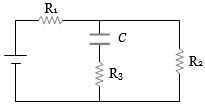
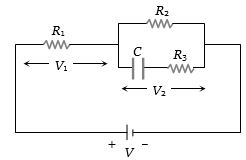
In the circuit here, the steady state voltage across capacitor $C$ is a fraction of the battery $e.m.f.$ The fraction is decided by
Medium


Download our appand get started for free
Experience the future of education. Simply download our apps or reach out to us for more information. Let's shape the future of learning together!No signup needed.*
Similar Questions
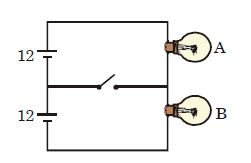
- 1Two light bulbs in the circuit have rating $A\,[24\ V, 48\,W]$ and $B\,[24\ V, 36\,W]$ as shown.View Solution
- 2A potentiometer consists of a wire of length $4\, m$ and resistance $10 \,\Omega$. It is connected to cell of $emf$ $2\, V$. The potential difference per unit length of the wire will be ............ $V/m$View Solution
- 3The resistance of the filament of an electric bulb changes with temperature. If an electric bulb rated $220\, volt$ and $100\, watt$ is connected $(220 \times 0.8)$ $volt$ sources, then the actual power would beView Solution
- 4Two wires with resistances $R$ and $2R$ are connected in parallel, the ratio of heat generated in $2R$ and $R$ isView Solution
- 5$A$ battery is of $\mathrm{emf}$ $E$ is being charged from a charger such that positive terminal of the battery is connected to terminal $A$ of charger and negative terminal of the battery is connected to terminal $B$ of charger. The internal resistance of the battery is $r$.View Solution
- 6In a meter bridge experiment null point is obtained at $20\, cm$ from one end of the wire when resistance $X$ is balanced against another resistance $Y$. If $X < Y$, then where will be the new position of the null point from the same end, if one decides to balance a resistance of $4X$ against $Y$ ........... $cm$View Solution
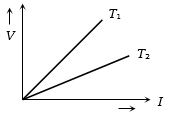
- 7The voltage $V$ and current $I$ graph for a conductor at two different temperatures ${T_1}$ and ${T_2}$ are shown in the figure. The relation between ${T_1}$ and ${T_2}$ isView Solution
- 8An electric heater of resistance $6 \,ohm$ is run for $10$ minutes on a $120\, volt$ line. The energy liberated in this period of time isView Solution
- 9What amount of heat will be generated in a coil of resistance $R$ due to a charge $q$ passing through it if the current in the coil decreases to zero uniformly during a time interval $\Delta t$View Solution
- 10$12$ cells each having same $emf$ are connected in series with some cells wrongly connected. The arrangement is connected in series with an ammeter and two cells which are in series. Current is $3 \,A$ when cells and battery aid each other and is $2\, A$ when cells and battery oppose each other. The number of cells wrongly connected isView Solution