Question
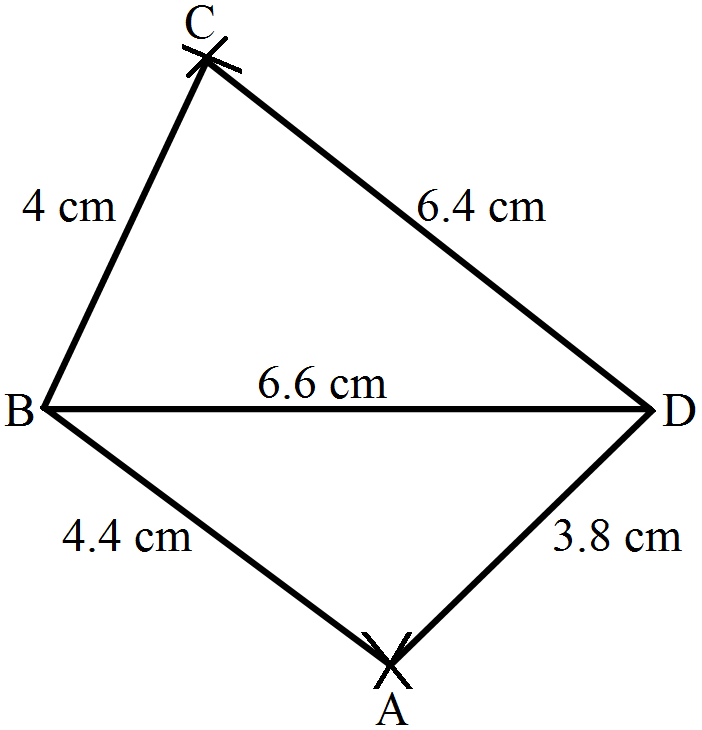
Construct a quadrilateral ABCD in which AB = 4.4cm, BC = 4cm, CD = 6.4cm, DA = 3.8cm and BD = 6.6cm.
Answer


First, we draw a rough sketch of the quadrilateral ABCD and write down its dimensions along the sides.
We may divide the quadrilateral into two constructible triangles ABD and BCD.
Steps of Construction:
Step I: Draw BD = 6.6cm
Step II: With B as the centre and radius BC = 4cm, draw an arc.
Step III: With D as the centre and radius 6.4cm, draw an are to intersect th are drawn in Step II at C.
Step IV: With B as the centre and radius 4.4cm, draw an arc on the side BD opposite to that of C.
Step V: With D as the centre and radius 3.8cm, draw an arc to intersect the arc drawn in Step IV at A.
Step VI: Join BA, DA, BC and CD The quadrilateral ABCD so obtained is the required quadrilateral.

Need a full question paper?

Generate a complete, print-ready paper with questions like this in minutes — across 16+ boards, with answer keys.

Start Generating Free

Similar questions

Use the given information and fill in the boxes with suitable numbers. Smt. Deepanjali purchased a house for Rs 7,50,000 from Smt. Leelaben through an agent. Agent has charged 2 % brokerage from both of them.
Given below is the result of an annual examination of a class, showing the percentage of students in each category.
First division
Second division
Third division
Failed
25%
45%
20%
10%
Represent the above data by a pie chart.
Solve the following equation and verify your answer:
$\frac{6}{2\text{x}-(3-4\text{x})}=\frac{2}{3}$
Construct a quadrilateral BDEF, where DE = 4.5cm, EF = 3.5cm, FB = 6.5cm, $\angle\text{F}=50^\circ$ and $\angle\text{E}=100^\circ.$
Construct a parallelogram PQRS such that PQ = 5.2cm, PR = 6.8cm and QS = 8.2cm.
Three equal cubes are placed adjacently in a row. Find the ratio of the total surface area of the new cuboid to that of the sum of the surface areas of the three cubes.
Plot a line graph for the variables x and y , where y = 2x + 1. Using the graph, find the value of.
  1. y, when x = 5 and
  2. x, when y = 13
Diagonals of parallelogram ABCD intersect at O as shown in the figure. XY contains O, and X, Y are points on opposite sides of the parallelogram. Give reasons for each of the following:
  1. $\text{OB}=\text{OD}$
  2. $\angle\text{OBY}=\angle\text{ ODX}$
  3. $\angle\text{BOY}=\angle\text{DOX}$
  4. $\triangle\text{BOY}=\triangle\text{DOX}$
Now, state if XY is bisected at O.
Find the following product and verify the result for x = -1, y = -2:
$\big(\frac{1}{3}\text{x}−\frac{\text{y}^2}{5}\big)\big(\frac{1}{3}\text{x}+\frac{\text{y}^2}{5}\big)$
Construct a quadrilateral PQRS, in which PQ = 3.5cm, QR = 2.5cm, RS = 4.1cm, $\angle\text{Q}=75^\circ$ and $\angle\text{R}=120^\circ.$