Question
Derive the condition of Constructive and destructive interference in terms of the phase difference.

Answer

The formula to find out the intensity of resultant wave generated due to super position of waves emanated from two coherent sources is, $I =4 I _0 \cos ^2\left(\frac{\phi}{2}\right)$ (where, $\phi$ - phase difference)
• Constructive Interference :
If the phase difference at the point of super position is
$\phi=0, \pm 2 \pi, \pm 4 \pi \ldots$ we will have constructive interference leading to maximum intensity.
→Condition : phase difference $= \pm 2 n \pi$
$(n=0,1,2,3 \ldots)$
• Destructive Interference :
If the phase difference at the point of super position is
$\phi= \pm \pi, \pm 3 \pi, \pm 5 \pi \ldots$ we will have destructive interference leading to zero intensity.
→Condition : phase difference $= \pm(2 n+1) \pi$
$(n=0,1,2,3 \ldots .)$

Need a full question paper?

Generate a complete, print-ready paper with questions like this in minutes — across 16+ boards, with answer keys.
Start Generating Free

Similar questions

A tightly-wound, long solenoid has n turns per unit length, a radius r and carries a current i. A particle having charge q and mass m is projected from a point on the axis in a direction perpendicular to the axis. What can be the maximum speed for which the particle does not strike the solenoid ?
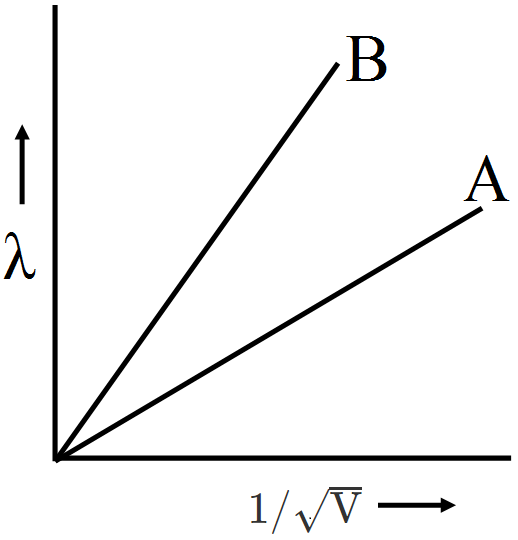
Two lines A and B shown in the graph represent the de Broglie wavelength $(\lambda)$ as a function of $\frac{1}{\sqrt{\text{V}}}$ (V is the accelerating potential) for two particles having the same charge. Which of the two represents the particle of smaller mass?
A farsighted person cannot see objects placed closer to 50cm. Find the power of the lens needed to see the objects at 20cm.
A rectangular coil of $100$ turns has length $5\ cm$ and width $4\ cm$. It is placed with its plane parallel to a uniform magnetic field and a current of $2A$ is sent through the coil. Find the magnitude of the magnetic field $B$ if the torque acting on the coil is $0.2\ N m^{-1}.$
A proton and an a particle are accelerated through the same potential difference. Which one of the two has (i) greater de-Broglie wavelength, and (ii) less kinetic energy? Justify your answer.
Explain the photoelectric effect when the radiation is incident on different metals?
A wire of resistance 16 ohm is clongated to double its lengths find the new resistance ?
A block of mass m moving at a speed v compresses a spring through a distance x before its speed is halved. Find the spring constant of the spring.
Give some commonly known ideas regarding magnetism.
Explain the behaviour of electric dipole in non-uniform electric field.