Question
Distinguish between electrolytic methods of reduction and refining ?

Answer

Electrolytic Reduction
(i) It is removal of oxide or halide from a metal.
(ii) Oxides of highly active metals like Na,K,Ca,Mg,Al are reduced by electrolytic reduction of their fused salts.
(iii) Oxides of these metals have great affinity for oxygen than carbon and cannot be reduced by carbon or CO or hydrogen.
Electrolytic refining of metals is the separation of residual impurities like Si and phosphorus.
(i) Presence of other metals and non-metals like Si and phosphorus.
(ii) Unreduced oxides and sulphides of metals.
It depends upon:
(i) Nature of metal
(ii) Purpose for which metal is to be obtained.
(iii) Nature of impurities present.
Impure metal is made anode while a thin sheet of pure metal is made cathode and electrolyte used is a salt of solution of a metal to be refined.

Need a full question paper?

Generate a complete, print-ready paper with questions like this in minutes — across 16+ boards, with answer keys.
Start Generating Free

Similar questions

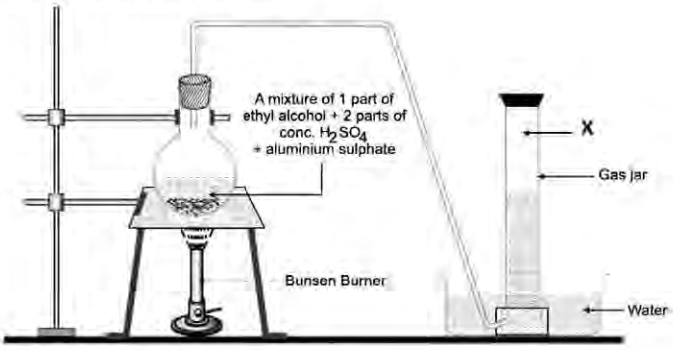
Look at the set-up of given apparatus carefully.
Image
(i) Identify 'X'.
(ii) Name the process of collection of 'X'. Justify.
(iii) Write the chemical equations involved.
(iv) What is the role of sulphuric acid in the above process?
During electrolysis of an aqueous solution of sulphuric acid between platinum electrodes, two types of anions migrate towards the anode but only one of themis discharged:
(a) Name the two anions,
(b) Name the main product of the discharge of anion at the anode and write the anode reaction,
(c) Name the product at the cathode and write the reaction.
(d) How you notice any change in colour. State why?
(e) Why this electrolysis, is considered as an example of catalysis?
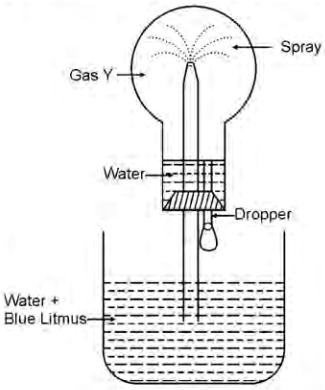
Study the figure given alongside and answer the questions that follow :
Image
(i) Name the experiment illustrated here.
(ii) Identify the gas Y.
(iii) What property of gas Y demonstrated by this experiment?
(iv) Explain the observations of the experiment.
Name the substance used for drying ammonia gas? Why cannot substances such as conc.$H_2SO_4$​​​​​​​, anhydrous calcium chloride and phosphorus pentoxide be used for drying ammonia gas?
With reference to the electrolysis of acidulated water, answer the following :
a) why distilled water is a non- electrolyte?
b) What is the electrolytic cell called?
c) State what you would observe at the (i) Cathode (ii) Anode
d) Summarize the electrode reactions.
e) why is electrolysis of acidulated water considered as an example of catalysis?
The table given below shows the hints about various compounds.
S.No.Hints
(i)Substance 'C' is used as a preservative
(ii)C' has two carbon atoms 'C' is obtained by the reaction of 'A' in presence of alkaline potassium permanganate followed by acidification.
(iii)Misuse of 'A' in industries is prevented by adding methanol, benzene, and pyridine to 'A'.
(iv)'F' is formed on heating 'A' in presence of conc. sulphuric acid.
(v)'F' reacts with hydrogen gas in presence of nickel and palladium catalyst.
Based on the above hints answer the following questions:
(a) Give the IUPAC names of A and F.
(b) Illustrate with the help of chemical equations the changes taking place. (A → C and A → F)
Answer the following question:
Write the chemical formula of one main ore of iron and aluminium.
Choosing only substances from the list given in the box below, write equations for the reactions which you would use in the laboratory to obtain:
(i) Sodium sulphate
(ii) Copper sulphate
(iii) Iron (II) sulphate
(iv) Zinc carbonate
Dilute sulphuric acidCopper, Iron,
Sodium, Zinc
Copper carbonate,
Sodium carbonate
Give the preparation of the salt given in the left column by matching with the methods given in the right column. Write balanced equations for each preparation.
Salt Method of Preparation
Zinc sulphate Precipitation
Ferrous sulphide Displacement
Barium sulphate Neutralization
Sodium sulphate Synthesis
Explain the term $: Mole$