Draw a well labelled diagram of photoelectric cell. Explain the observations made by Hertz and Lenard about the phenomenon of photoelectric emission.
(Oct 2013)
Download our app for free and get started
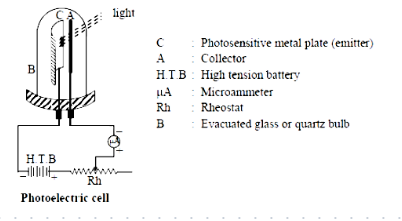
Observations made by Hertz and Lenard:
a) The phenomenon of photoelectric emission was discovered in 1887 by Heinrich Hertz.
b) During his experimental investigation on the production of electromagnetic waves by
means of a spark discharge, Hertz observed that high voltage sparks across the detector
loop were enhanced when the emitter plate was illuminated by ultraviolet light from an
arc lamp.
c) Lenard observed that when ultraviolet radiations were allowed to fall on the emitter
plate of an evacuated glass tube enclosing two electrodes (metal plates), current flows
in the circuit.
d) As soon as the ultraviolet radiations were stopped, the current flow also stopped. These observations indicated that when ultraviolet radiations fall on the emitter plate C,
electrons are ejected from it which are attracted towards the positive collector plate A by
the electric field.
e) The electron flow through the surface of emitter caused current in the external circuit.
f) Hallwachs and Lenard studied how this photocurrent varied with collector plate
potential, frequency and intensity of incident light.

Download our appand get started for free
Experience the future of education. Simply download our apps or reach out to us for more information. Let's shape the future of learning together!No signup needed.*
Similar Questions
- 1View SolutionThe work function for a metal surface is \(2.2 eV\). If light of wavelength 5000Å is incident on the surface of the metal, find the threshold frequency and incident frequency. Will there be an emission of photoelectrons or not? \(\left(c=3 \times 10^8 m / s , 1 eV =1.6 \times 10^{-19} J , h =6.63 \times 10^{-34} J . s\right.\). \()\)
- 2View SolutionWith a neat, labelled schematic diagram, explain the experimental set-up for photoelectric effect
- 3View SolutionThe photoelectric current in a photoelectric cell can be reduced to zero by a stopping potential of 1.8 volt. Monochromatic light of wavelength 2200Å is incident on the cathode. Find the maximum kinetic energy of the photoelectrons in joules. [Charge on electron \(=1.6 \times 10^{-19} C\)]
- 4View SolutionWhat is photoelectric effect? Define: (i) Stopping potential, (ii) Photoelectric work function.
- 5View SolutionState Einstein's photoelectric equation. Explain two characteristic of photoelectric effect on the basis of Einstein photoelectron equation.
- 6View SolutionThe photoelectric work function for a metal is \(4.2 eV\). If the stopping potential is \(3 V\), find the threshold wavelength and maximum kinetic energy of emitted electrons. (Velocity of light in air \(=3 \times 10^8 m / s\),) Planck's constant \(=6.63 \times 10^{-34} J - s\), Charge on electron \(=1.6 \times 10^{-19} C\) )
- 7View SolutionState Einstein's photoelectric equation. Explain any two characteristics of photoelectric effect on the basis of this equation.
- 8View SolutionThe work functions for potassium and cesium are \(2.25 eV\) and \(2.14 eV\) respectively. Is the photoelectric effect possible for either of them if the incident wavelength is 5180 ?
[Given : Planck's constant \(=6.63 \times 10^{-34} J . s\); Velocity of light \(=3 \times 10^8 m / s ; 1 eV =1.6 \times 10^{-19} J\) ] - 9View SolutionWhat is de-Broglie hypothesis? Obtain the relation for de-Broglie wavelength.
- 10View SolutionLight of wavelength 3000Å falls on a metal surface having work function \(2.3 eV\). Calculate the maximum velocity of ejected electrons. (Planck's constant \(h=6.63 \times 10^{34}\) J.s., Velocity of light \(c=3 \times 10^8 m / s\), Mass of an electron \(=9.1 \times 10^{-31} kg\) )