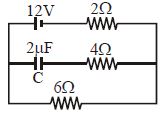
Find the charge on the capacitor $C$ in the following circuit ............. $\mu C$
Medium
Download our app for free and get started
At steady state current will not flow in branch that contains capacitator, so $6 \Omega$ and $2 \Omega$ will become in series so net current $\left(\frac{12}{6+2}\right)$ Resistor of $4 \Omega$ will become short circuited $I_{n e t}=\frac{3}{2} A$
Voltage across capacitor = Voltage across $6 \Omega$ $\frac{q}{C}=i R$
$\frac{q}{2 \times 10^{-6}}=\frac{3}{2} \times 6$
$q=18 \times 10^{-6}$
$q=18 \mu C$

Download our appand get started for free
Experience the future of education. Simply download our apps or reach out to us for more information. Let's shape the future of learning together!No signup needed.*
Similar Questions
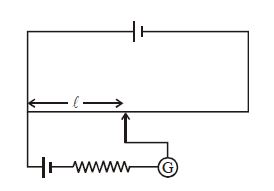
- 1In a potentiometer (see figure) a balance is obtained at a length of $400\ mm$ when using a known battery of emf $1.6\ V$. After removing this battery, another battery of unknown emf is used and balance is obtained at a length of $650\ mm.$ The emf of unknown battery is ............. $volt$View Solution
- 2View SolutionAssertion : The electric bulbs glows immediately when switch is on.
Reason : The drift velocity of electrons in a metallic wire is very high.
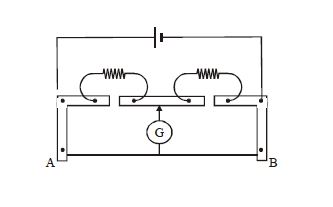
- 3A meter bridge set up as shown to determine end correction at $A$ and $B$. When a resistance of $15\ \Omega$ is used in left gap and of $20\ \Omega$ in right gap, then null point comes at a distance $42\ cm$ from $A$. When these resistances are interchanged null point comes at a distance $57\ cm$ from $A$. Values of end corrections areView Solution
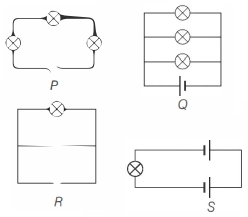
- 4Following figures show different combinations of identical bulb$(s)$ connected to identical battery$(ies)$. Which option is correct regarding the total power dissipated in the circuit?View Solution
- 5Resistors of $1$, $2$, $ohm$ are connected in the form of a triangle. If a $1.5\, volt$ cell of negligible internal resistance is connected across $3\, ohm$ resistor, the current flowing through this resistance will be ................ $amp$View Solution
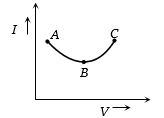
- 6View SolutionResistance as shown in figure is negative at
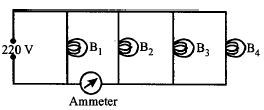
- 7Four bulbs $B_1 , B_2, B_3$ and $B_4$ of $100\, W$ each are connected to $220\, V$ main as shown in the figure. The reading in an ideal ammeter will be ............... $A$View Solution
- 8A house is served by $220\, V$ supply line in a circuit protected by a $9\, ampere$ fuse. The maximum number of $60\, W$ lamps in parallel that can be turned on, isView Solution
- 9Drift velocity ${v_d}$ varies with the intensity of electric field as per the relationView Solution
- 10Each of the resistance in the network shown in fig. is equal to $R$. The resistance between the terminals $A$ and $B$ isView Solution