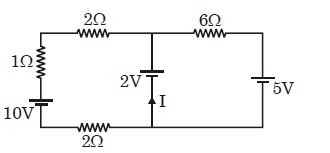
Find the value of $I$ ?................ $\mathrm{A}$
Diffcult
Download our app for free and get started
in loop $\mathrm{ABEFA}$
$I_{1}=\frac{8}{5} \,A=1.6 \,A$
in loop $\mathrm{BCDEB}$
$I_{1}=\frac{3}{6}=0.5 \mathrm{\,A}$
$\mathrm{I}=-\left(\mathrm{I}_{1}+\mathrm{I}_{2}\right)$
$\mathrm{I}=-2.1 \mathrm{\,A}$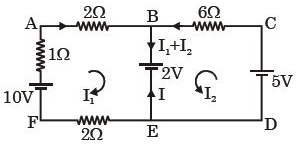

Download our appand get started for free
Experience the future of education. Simply download our apps or reach out to us for more information. Let's shape the future of learning together!No signup needed.*
Similar Questions
- 1A potential difference of $10 \,V$ is applied across a conductor of $1000 \,\Omega$. The number of electrons flowing through the conductor in $300 \,s$ is ..........View Solution
- 2A cell having an emf $\varepsilon$ and internal resistance $r$ is connected across a variable external resistance $R.$ As the resistance $R$ is increased, the plot of potential difference $V$ across $R$ is given byView Solution
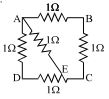
- 3$ABCD$ is a square where each side is a uniform wire of resistance $1\,\Omega$ . $A$ point $E$ lies on $CD$ such that if a uniform wire of resistance $1\,\Omega$ is connected across $AE$ and constant potential difference is applied across $A$ and $C$ then $B$ and $E$ are equipotential.View Solution
- 4$n$ identical bulbs, each designed to draw a power $p$ from a certain voltage supply, are joined in series across that supply. The total power which they will draw isView Solution
- 5Two identical cells each of emf $1.5 \,V$ are connected in parallel across a parallel combination voltmeter connected in the circuit measures $1.2 \,V$.View Solution
The internal resistance of each cell is.................$\Omega$
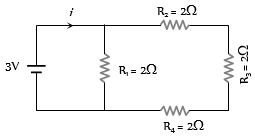
- 6What is the current $(i)$ in the circuit as shown in figure ........... $A$View Solution
- 7To get the maximum current from a parallel combination of $n$ identical cells each of internal resistance $r$ in an external resistance $R$, whenView Solution
- 8Two wires $A$ and $B$ made of same material and having their lengths in the ratio $6 : 1$ are connected in series. The potential difference across the wires are $3\,V$ and $2\,V$ respectively. If $r_A$ and $r_B$ are the radii of $A$ and $B$ respectively, then $\frac{{{r_B}}}{{{r_A}}}$ isView Solution
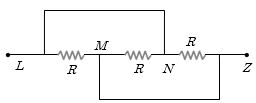
- 9Three equal resistances each of value $R$ are joined as shown in the figure. The equivalent resistance between $M$ and $N$ isView Solution
- 10On giving $220\,V$ to a resistor the power dissipated is $40\,W$ then value of resistance is ............... $\Omega$View Solution