On giving $220\,V$ to a resistor the power dissipated is $40\,W$ then value of resistance is ............... $\Omega$
Easy
Download our app for free and get started
(a) $P = \frac{{{V^2}}}{R} \Rightarrow R = \frac{{{V^2}}}{P} = \frac{{{{(220)}^2}}}{{40}} = 1210\,\Omega $

Download our appand get started for free
Experience the future of education. Simply download our apps or reach out to us for more information. Let's shape the future of learning together!No signup needed.*
Similar Questions
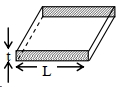
- 1Consider a thin square sheet of side $\mathrm{L}$ and thickness $\mathrm{t}$, made of a material of resistivity $\rho$. The resistance between two opposite faces, shown by the shaded areas in the figure isView Solution
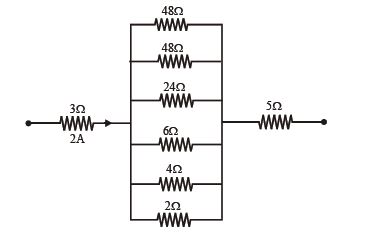
- 2Find potential difference across $24\,\Omega $ ............. $\mathrm{volt}$View Solution
- 3The current in a wire varies with time according to relation $I = 4 + 2t$. The quantity of charge which has passed through a crosssectionn of the wire during the time $t = 2\, s$ to $t = 6\, s$ will be .............. $\mathrm{C}$View Solution
- 4Resistance of a wire at $0^{\circ} \mathrm{C}, 100^{\circ} \mathrm{C}$ and $t^{\circ} \mathrm{C}$ is found to be $10 \Omega, 10.2 \Omega$ and $10.95 \Omega$ respectively. The temperature $t$ in Kelvin scale is $\qquad$View Solution
- 5For which of the following dependence of drift velocity $v$ on electric field $E$ is ohm's law obeyedView Solution
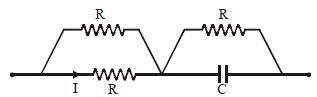
- 6View SolutionThe capacitor shown in fig. is in steady state. The energy stored in the capacitor is
- 7A current of $2\,A$ flows through a wire of crosssectional area $25.0\,mm ^2$. The number of free electrons in a cubic meter are $2.0 \times 10^{28}$. The drift velocity of the electrons is $...............\times 10^{-6}\,ms ^{-1}$ (given, charge on electron $=1.6 \times 10^{-19}\,C$ )View Solution
- 8Two resistors are joined in parallel whose, resultant is $\frac{6}{5} \,\Omega$. One of the resistance wire is broken and the effective resistance becomes $2 \,ohms$. Then the resistance (in $ohm$) of the wire that got broken is ..........View Solution
- 9An electric bulb rated as $200\, {W}$ at $100 \,{V}$ is used in a circuit having $200\, {V}$ supply. The resistance $'R'$ that must be put in series with the bulb so that the bulb delivers the same power is $.....\,\Omega$View Solution
- 10A potentiometer has uniform potential gradient. The specific resistance of the material of the potentiometer wire is $10^{-7} \, ohm-meter$ and the current passing through it is $0.1\, ampere$; cross-section of the wire is $10^{-6}\, m^2$. The potential gradient along the potentiometer wire isView Solution