MCQ
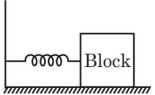
For a simple harmonic motion in a mass spring system shown, the surface is frictionless. When the mass of the block is $1\,kg$, the angular frequency is $\omega_1$. When the mass block is $2\,kg$ the angular frequency is $\omega_2$. The ratio $\omega_2 / \omega_1$ is
  • A
    $\sqrt{2}$
  • $\frac{1}{\sqrt{2}}$
  • C
    $2$
  • D
    $\frac{1}{2}$

Answer

Correct option: B.
$\frac{1}{\sqrt{2}}$
b
$\omega=\sqrt{\frac{ k }{ m }}$

$\frac{\omega_2}{\omega_1}=\sqrt{\frac{ m _1}{ m _2}}=\sqrt{\frac{1}{2}}$

Need a full question paper?

Generate a complete, print-ready paper with questions like this in minutes — across 16+ boards, with answer keys.

Start Generating Free

Similar questions

Two equal rods joined at one end are kept on a smooth surface as shown and released. Trajectory of centre of mass of both rods is 
If $\overrightarrow P .\overrightarrow Q = PQ,$ then angle between $\overrightarrow P $and $\overrightarrow Q $ is ....... $^o$
A bag is gently dropped on a conveyor belt moving at a speed of $2\,m / s$. The coefficient of friction between the conveyor belt and bag is $0.4$ Initially, the bag slips on the belt before it stops due to friction. The distance travelled by the bag on the belt during slipping motion is $.....m$ [Take $g=10\,m / s ^{-2}$ ]
Can the resultant of $2$ vectors be zero
If the length of a stretched string is doubled and the tension is four times then new frequency will be times of old frequency.
A loaded spring gun of mass M fires a 'shot' of mass m with a velocity at an angle of elevation $\theta.$ The gun is initially at rest on a horizontal frictionless surface. After firing, the centre of mass of the gun-shot system.
A block is kept on an inclined plane of inclination $\theta$ of length l. The velocity of particle at the bottom of inclined is (the coefficient of friction is $\mu$)
A running man has half the kinetic energy of that of a boy of half of his mass. The man speeds up by $1\,m/s$ so as to have same K.E. as that of the boy. The original speed of the man will be
Match the column $-I$ with column $-II$ For a satellite in circular orbit,

  Column $-I$   Column $-II$
$(A)$ Kinetic energy $(p)$ $ - \frac{{G{M_E}m}}{{2r}}$
$(B)$ Potential energy $(q)$ $\sqrt {\frac{{G{M_E}}}{r}} $
$(C)$ Total energy $(r)$ $ - \frac{{G{M_E}m}}{{r}}$
$(D)$ Orbital energy $(s)$ $ \frac{{G{M_E}m}}{{2r}}$

 (where $M_E$ is the mass of the earth, $m$ is mass of the satellite and $r$ is the radius of the orbit)

The lower surface of a cube is fixed. On its upper surface, force is applied at an angle of $30°$ from its surface. The change will be of the type