MCQ
For which one of the following, Bohr model is not valid?
  • A
    Singly ionized helium atom ( He+ )
  • B
    Hydrogen atom
  • Singly ionized neon atom ( Ne+ )
  • D
    Deuteron atom

Answer

Correct option: C.
Singly ionized neon atom ( Ne+ )
(C)Singly ionized neon atom (Ne+)
Explanation:
Singly ionized neon has electron count more than one. Bohr's model is valid for atoms with single electron.

Need a full question paper?

Generate a complete, print-ready paper with questions like this in minutes — across 16+ boards, with answer keys.

Start Generating Free

Similar questions

On a railway curve, the outside rail is laid higher than the inside one so that resultant force exerted on the wheels of the rail car by the tops of the rails will
A man is standing in a lift which goes up and comes down with the same constant acceleration. If the ratio of the apparent weights in the two cases is $2 : 1$, then the acceleration of the lift is  ......... $m/s^2$
A radioactive nucleus $A$ with a half life $T$, decays into a nucleus $B.$ At $t = 0$, there is no nucleus $B$. At sometime $t$, the ratio of the number of $B$ to that of $A$ is $0.3$. Then, $t$ is given by
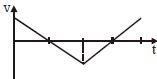
The graph below shows the velocity versus time graph for a body.

Which of the following graphs represents the corresponding acceleration $v/s$ time graph ?
Boyle's law holds for an ideal gas during
A man, standing between two cliffs, claps his hands and starts hearing a series of echoes at intervals of one second. If the speed of sound in air is $340 ms^{-1}$, the distance between the cliffs is  .... $m$
Two beams of light having intensities $I$ and $4I$ interfere to produce a fringe pattern on a screen. The phase difference between the beams is $\frac{\pi }{2}$ at point $A$ and $\pi$ at point $B$. Then the difference between the resultant intensities at $A$ and $B$ is
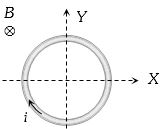
A conducting loop carrying a current $I$ is placed in a uniform magnetic field pointing into the plane of the paper as shown. The loop will have a tendency to
A spaceship in space sweeps stationary interplanetary dust. As a result, its mass increases at a rate $\frac{ dM ( t )}{ dt }= bv ^{2}( t ),$ where $v ( t )$ is its instantaneous velocity. The instantaneous acceleration of the satellite is
$4200\, J$ of work is required for