MCQ
Given below are two statements :-

Statement $I$ : Davisson-Germer experiment establishes the wave nature of electrons.

Statement $II$ : If electrons have wave nature, they can interfere and show diffraction.

In the light of the above statements choose the correct answer from the options given below

  • Both Statement $I$ and Statement $II$ are true
  • B
    Both Statement $I$ and Statement $II$ are false
  • C
    Statement $I$ is true but Statement $II$ is false
  • D
    Statement $I$ is false but Statement $II$ is true
Answer

Correct option: A.
Both Statement $I$ and Statement $II$ are true
a
In Davisson$-$Germer experiment the electrons exhibit diffraction there by proving that electrons have wave nature. Hence both statement are correct.

Both the options are correct by concept

Need a full question paper?

Generate a complete, print-ready paper with questions like this in minutes — across 16+ boards, with answer keys.

Start Generating Free

Similar questions

The Einstein’s photo$-$electric equation is based upon the conservation of:
Choose the correct option from the following options given below
Two long straight parallel conductors separated by a distance of $0.5\,m$ carry currents of $5\,A$ and $8\,A$ in the same direction. The force per unit length experienced by each other is
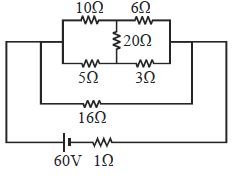
The current from the cell for the given circuit is ................ $\mathrm{A}$
In a potentiometer experiment, the galvanometer shows no deflection when a cell is connected across $60\, cm$ of the potentiometer wire. If the cell is shunted by a resistance of $6\,\Omega $, the balance is obtained across $50\, cm$ of the wire. The internal resistance of the cell is .............. $\Omega $
If Fresnel’s biprism experiment as held in water inspite of air, then what will be the effect on fringe width
A potentiometer wire is $100\ cm$ long and a constant potential difference is maintained across it. Two cells are connected in series first to support one another and then in opposite direction. The balance points are obtained at $50\ cm$ and $10\ cm$ from the positive end of the wire in the two cases. The ratio of emf's is:
A thin diamagnetic rod is placed vertically between the poles of an electromagnet. When the current in the electromagnet is switched on, then the diamagnetic rod is pushed up, out of the horizontal magnetic field. Hence, the rod gains gravitational potential energy. The work required to do this comes from:
Field lines start from$........$ charges and ends at $........$ charges.
A pulse of light of duration $100 \ ns$ is absorbed completely by a small object initially at rest. Power of the pulse is $30 \ mV$ and the speed of light is $3 \times 10 ^8\ ms ^{-1}$. The final momentum of the object is :