How many calories of heat will be produced approximately in a $210\, watt$ electric bulb in $5$ minutes .............. $cal $
Easy
Download our app for free and get started
(d) $H = \frac{{{V^2}t}}{{R \times J}}\,Calories = \frac{{P\,t}}{J} = \frac{{210 \times 5 \times 60}}{{4.2}} = 15000\,cal$

Download our appand get started for free
Experience the future of education. Simply download our apps or reach out to us for more information. Let's shape the future of learning together!No signup needed.*
Similar Questions
- 1Time taken by a $836\; W$ heater to heat $1\; litre$ of water from $10^{\circ} C$ to $40^{\circ} C$ isView Solution
- 2Two bulbs of $500\, watt$ and $200\, watt$ are manufactured to operate on $220\, volt$ line. The ratio of heat produced in $500\, W$ and $200\, W$, in two cases, when firstly they are joined in parallel and secondly in series, will beView Solution
- 3$A$ uniform copper wire carries a current $i$ amperes and has $p$ carriers per meter$^3$. The length of the wire is $\lambda$ meters and its cross-section area is $s$ meter $^2$. If the charge on a carrier is $q$ coulombs, the drift velocity in $ms^{-1}$ is given byView Solution
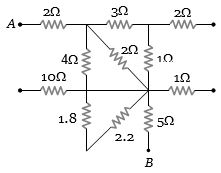
- 4What is the equivalent resistance between the points $A$ and $B$ of the network .................. $\Omega$View Solution
- 5The total momentum of electrons in a straight wire of copper of length $1\, metre$ carrying a current of $16\, A$ isView Solution
- 6A ($100\, W$, $200\, V$) bulb is connected to a $160\, V$ power supply. The power consumption would be ............. $W$View Solution
- 7The resistances of a wire at temperatures $t\,^oC$ and $0\,^oC$ are related byView Solution
- 8Space between two concentric conducting spheres of radii $a$ and $b (b > a)$ is filled with $a$ medium of resistivity $\rho $. The resistance between the two spheres will beView Solution
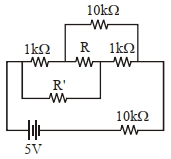
- 9When the resistance $R$ (indicated in the figure below) is changed from $1 \,k \Omega$. to $10 \,k \Omega$, the current flowing through the resistance $R'$ does not change. What is the value of the resistor $R'?$View Solution
- 10The resistivity $(\rho)$ of semiconductor varies with temperature. Which of the following curve represents the correct behaviourView Solution