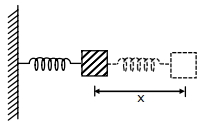
If a simple pendulum oscillates with an amplitude of $50\, mm$ and time period of $2\, sec$, then its maximum velocity is .... $m/s$
AIIMS 1998, Easy


Download our appand get started for free
Experience the future of education. Simply download our apps or reach out to us for more information. Let's shape the future of learning together!No signup needed.*
Similar Questions
- 1The total mechanical energy of a particle in $SHM$ isView Solution
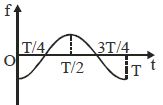
- 2A body is performing simple harmonic motion with amplitude a and time period $T$. Variation of its acceleration $(f)$ with time $(t)$ is shown in figure. If at time $t$, velocity of the body is $v$, which of the following graphs is correctView Solution
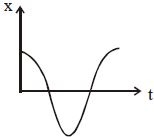
- 3Dispacement time graph of a particle executing $SHM$ is as shown in the figure. Corresponding graph between $PE$ and time isView Solution
- 4A simple pendulum is hanging from a peg inserted in a vertical wall. Its bob is stretched in horizontal position from the wall and is left free to move. The bob hits on the wall the coefficient of restitution is $\frac{2}{{\sqrt 5 }}$. After how many collisions the amplitude of vibration will become less than $60°$View Solution
- 5A body is in simple harmonic motion with time period half second $(T\, = 0.5\, s)$ and amplitude one $cm\, (A\,= 1\, cm)$. Find the average velocity in the interval in which it moves form equilibrium position to half of its amplitude .... $cm/s$View Solution
- 6View SolutionThe frequency at which its kinetic energy change into potential energy is
- 7A pendulum bob is swinging in a vertical plane such that its angular amplitude is less than $90^o$. At its highest point, the string is cut. Which trajectory is possible for the bob afterwards.View Solution
- 8Two equations of two $S.H.M.$ are $y = a\sin \,(\omega \,t - \alpha )$ and $y = b\cos (\omega \,t - \alpha )$. The phase difference between the two is .... $^o$View Solution
- 9A particle performs simple harmonic motion with amplitude A. Its speed is increased to three times at an instant when its displacement is $\frac{2 \mathrm{~A}}{3}$. The new amplitude of motion is $\frac{\mathrm{nA}}{3}$. The value of $\mathrm{n}$ is____.View Solution
- 10The motion of a mass on a spring, with spring constant ${K}$ is as shown in figure. The equation of motion is given by $x(t)= A sin \omega t+ Bcos\omega t$ with $\omega=\sqrt{\frac{K}{m}}$ Suppose that at time $t=0$, the position of mass is $x(0)$ and velocity $v(0)$, then its displacement can also be represented as $x(t)=C \cos (\omega t-\phi)$, where $C$ and $\phi$ areView Solution