Two wires $A$ and $B$ of same material and mass have their lengths in the ratio $1 : 2$. On connecting them to the same source, the rate of heat dissipation in $B$ is found to be $5\,W$. The rate of heat dissipation in $A$ is............ $W$
Medium
Download our app for free and get started
(c) $\frac{H}{t} = P = \frac{{{V^2}}}{R} \Rightarrow P \propto \frac{1}{R}$ also $R \propto \frac{l}{A} \propto \frac{{{l^2}\rho }}{{A.l\rho }}$
$ \Rightarrow $ $R \propto \frac{{{l^2}}}{m}$ $ \Rightarrow $ $R \propto {l^2}$ (for same mass)
So $\frac{{{P_A}}}{{{P_B}}} = \frac{{l_B^2}}{{l_A^2}} = \frac{4}{1} \Rightarrow {P_A} = 20\,W$
$ \Rightarrow $ $R \propto \frac{{{l^2}}}{m}$ $ \Rightarrow $ $R \propto {l^2}$ (for same mass)
So $\frac{{{P_A}}}{{{P_B}}} = \frac{{l_B^2}}{{l_A^2}} = \frac{4}{1} \Rightarrow {P_A} = 20\,W$

Download our appand get started for free
Experience the future of education. Simply download our apps or reach out to us for more information. Let's shape the future of learning together!No signup needed.*
Similar Questions
- 1View SolutionFor which of the following the resistance decreases on increasing the temperature
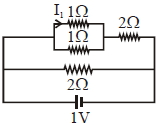
- 2The current $I_{1}$ (in $A$) flowing through $1\; \Omega$ resistor in the following circuit is:View Solution
- 3$3$ identical bulbs are connected in series and these together dissipate a power $P$. If now the bulbs are connected in parallel, then the power dissipated will beView Solution
- 4View SolutionIf in the experiment of Wheatstone's bridge, the positions of cells and galvanometer are interchanged, then balance points will
- 5A wire of $1 \,\Omega$ has a length of $1\, m$. It is stetched till its length increases by $25\, \%$. The percentage change in resistance to the neartest integer is .....$\%$View Solution
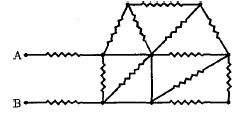
- 6In the given circuit all resistances are of value $R\,ohm$ each. The equivalent resistance between $A$ and $B$ isView Solution
- 7View SolutionWe are able to obtain fairly large currents in a conductor because
- 8Potentiometer wire of length $1 \,m$ is connected in series with $490\,\Omega $ resistance and $2\,V$ battery. If $0.2\, mV/cm $ is the potential gradient, then resistance of the potentiometer wire is ................ $\Omega$View Solution
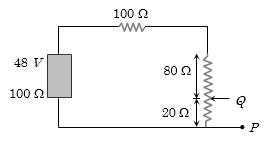
- 9In the circuit, the potential difference across $PQ$ will be nearest to .............. $V$View Solution
- 10Two bulbs are working in parallel order. Bulb $A$ is brighter than bulb $B$. If ${R_A}$ and ${R_B}$ are their resistance respectively thenView Solution