In a seconds pendulum, mass of bob is $30\, g$. If it is replaced by $90\, g$ mass. Then its time period will be ... $\sec$
Easy


Download our appand get started for free
Experience the future of education. Simply download our apps or reach out to us for more information. Let's shape the future of learning together!No signup needed.*
Similar Questions
- 1$Assertion :$ The time-period of pendulum, on a satellite orbiting the earth is infinity.View Solution
$Reason :$ Time-period of a pendulum is inversely proportional to $\sqrt g$ - 2In the figure, ${S_1}$ and ${S_2}$ are identical springs. The oscillation frequency of the mass $m$ is $f$. If one spring is removed, the frequency will becomeView Solution
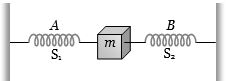
- 3A particle executing simple harmonic motion of amplitude $5\, cm$ has maximum speed of $31.4\, cm/s$. The frequency of its oscillation is ..... $Hz$View Solution
- 4A potential is given by $V(x)=k(x+a)^2 / 2$ for $x < 0$ and $V(x)=k(x-a)^2 / 2$ for $x > 0$. The schematic variation of oscillation period $T$ for a particle performing periodic motion in this potential as a function of its energy $E$ isView Solution
- 5The displacement time graph of a particle executing $S.H.M.$ is as shown in the figureThe corresponding force-time graph of the particle isView Solution
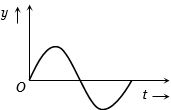
- 6A mass of $0.2\,kg$ is attached to the lower end of a massless spring of force-constant $200\, N/m,$ the upper end of which is fixed to a rigid support. Which of the following statements is/are true ?View Solution
- 7A particle is vibrating in a simple harmonic motion with an amplitude of $4\, cm.$ At what displacement from the equilibrium position, is its energy half potential and half kineticView Solution
- 8The displacement y of a particle executing periodic motion is given by $y = 4{\cos ^2}(t/2)\sin (1000t)$. This expression may be considered to be a result of the superposition of ........... independent harmonic motionsView Solution
- 9The maximum speed of a particle executing $S.H.M.$ is $1\,m/s$ and its maximum acceleration is $1.57\,m/se{c^2}$. The time period of the particle will be .... $\sec$View Solution
- 10A mass $m$ attached to a spring oscillates every $2\, sec$. If the mass is increased by $2 \,kg$, then time-period increases by $1\, sec$. The initial mass is ..... $kg$View Solution