MCQ
In an electromagnetic wave the electric field vector and magnetic field vector are given as $\vec{E}=E_{0} \hat{i}$ and $\vec{B}=B_{0} \hat{k}$ respectively. The direction of propagation of electromagnetic wave is along.
  • A
    $\hat{j}$
  • B
    $(\hat{k})$
  • C
    $(-\hat{k})$
  • $(-\hat{j})$

Answer

Correct option: D.
$(-\hat{j})$
d
Direct of propagation $=\vec{E} \times \vec{B}=\hat{i} \times \hat{k}=-\hat{j}$

Need a full question paper?

Generate a complete, print-ready paper with questions like this in minutes — across 16+ boards, with answer keys.

Start Generating Free

Similar questions

If an electron revolves in the path of a circle of radius of $0.5 × 10^{-10}\, m$ at frequency of $5 × 10^{15}$ $cycles/s$ the electric current in the circle is ..................$mA$ (Charge of an electron $=1.6 × 10^{-19}\, C$ )
Light of frequency n is incident on a certain photoelectric substance with threshold frequency $\mathrm{n}_0$. The work function for the substance is
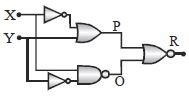
Figure gives a system of logic gates. From the study of truth table it can be found that to produce a high output $(1)$ at $R$, we must have
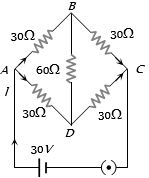
The current between $B$ and $D$ in the given figure is .............. $amp$
In a nuclear reaction, which of the following is conserved
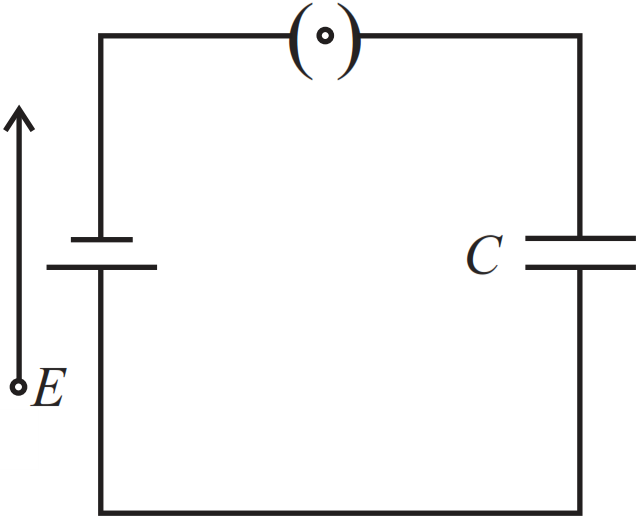
A parallel plate capacitor is connected to a battery as shown in Fig. Consider two situations: A: Key K is kept closed and plates of capacitors are moved apart using insulating handle. B: Key K is opened and plates of capacitors are moved apart using insulating handle. Choose the correct option(s).
The alternating current is given by

${i}=\left\{\sqrt{42} \sin \left(\frac{2 \pi}{{T}} {t}\right)+10\right\} {A}$

The $r.m.s.$ value of this current is ${A}$

The total mechanical energy of a spring $-$ mass system in $1$ simple harmonic motion is $\text{E}=\frac{1}{2}\text{m}\omega^2\text{A}^2.$ Suppose the oscillating particle is replaced by another particle of double the mass while the amplitude $A$ remains the same. The new mechanical energy will:
The refractive index of a particular material is $1.67 $ for blue light, $1.65$ for yellow light and $1.63$ for red light. The dispersive power of the material is .........
If a unit positive charge is taken from one point to another over an equipotential surface, then