In potentiometer a balance point is obtained, when
Easy
Download our app for free and get started
(b) In general, if the arrangement is not balanced, there will be a potential difference across the galvanometer, $G.$ This will only be zero means balance when the $p.d.$ of the wire between the $+ve$ end of battery to jockey becomes equal to the $e.m.f.$ of the experimental cell.

Download our appand get started for free
Experience the future of education. Simply download our apps or reach out to us for more information. Let's shape the future of learning together!No signup needed.*
Similar Questions
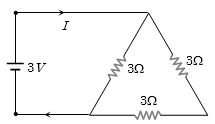
- 1A $3\, volt$ battery with negligible internal resistance is connected in a circuit as shown in the figure. The current $I$, in the circuit will be ............. $A$View Solution
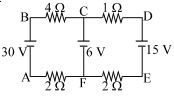
- 2View SolutionThe figure shows a network of four resistances and three batteries Which of the battery is getting charged.
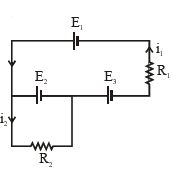
- 3The current $i_1$ and $i_2$ through the resistors $R_1(=10\,\Omega )$ and ${R_2}\left( { = 30\,\Omega } \right)$ in the circuit diagram with $E_1 = 3\,V$, $E_2 = 3\,V$ and $E_3 = 2\,V$ are respectivelyView Solution
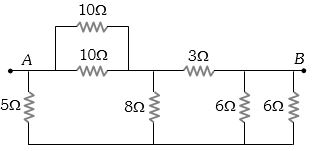
- 4Seven resistances are connected as shown in the figure. The equivalent resistance between $A$ and $B$ is ............... $\Omega$View Solution
- 5View SolutionIf a high power heater is connected to electric mains, then the bulbs in the house become dim, because there is a
- 6A current of two amperes is flowing through a cell of $e.m.f.$ $5\, volts$ and internal resistance $0.5\, ohm$ from negative to positive electrode. If the potential of negative electrode is $10\,V$, the potential of positive electrode will be .............. $V$View Solution
- 7View SolutionThe conductivity of a superconductor is
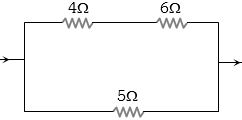
- 8In the circuit shown in figure, the heat produced in $5\, ohm $ resistance is $10\, cal / sec$ . The heat produced in $4$ resistance is ................ $cal /sec$View Solution
- 9A $1\,m$ long copper wire carries a current of $1\,A$. If the cross section of the wire is $2.0\,mm ^{2}$ and the resistivity of copper is $1.7 \times 10^{-8}\,\Omega\,m$. the force experienced by moving electron in the wire is $\times 10^{-23}\,N$. (charge on electron $=1.6 \times 10^{-19}\,C$ )View Solution
- 10Electric room radiator which operates at $225\, volts$ has resistance of $50\, ohms$. Power of the radiator is approximately ............... $W$View Solution