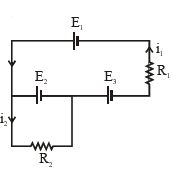
The current $i_1$ and $i_2$ through the resistors $R_1(=10\,\Omega )$ and ${R_2}\left( { = 30\,\Omega } \right)$ in the circuit diagram with $E_1 = 3\,V$, $E_2 = 3\,V$ and $E_3 = 2\,V$ are respectively
Medium
Download our app for free and get started
$I_{1}=\frac{3-1}{10}=0.2 \,A$
$I_{2}=\frac{3-0}{30}=0.1 \,A$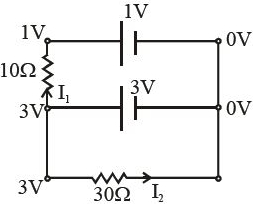

Download our appand get started for free
Experience the future of education. Simply download our apps or reach out to us for more information. Let's shape the future of learning together!No signup needed.*
Similar Questions
- 1Temperature coefficient at $0\,^oC$ is $0.00125\,^oC^{-1}$. At a temperature of $25\,^oC$ its resistance is $1\,\Omega $. Find the temperature at which resistance is $1.2\,\Omega $View Solution
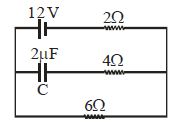
- 2Find the maximum charge on the capacitor $C$ in the following circuit ............ $\mu C$View Solution
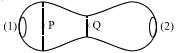
- 3Ametallic conductor of irregular cross-section is as shown in the figure. Aconstant potential difference is applied across the ends $(1)$ and $(2)$. Then :View Solution
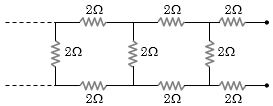
- 4View SolutionThe equivalent resistance of the following infinite network of resistances is
- 5The current in a conductor is expressed as $I=3 t^2+4 t^3$, where $I$ is in Ampere and $t$ is in second. The amount of electric charge that flows through a section of the conductor during $t=1$ s to $t=2 \mathrm{~s}$ is_______ C.View Solution
- 6Which of the following graph represents the variation of resistivity ( $\rho$ ) with temperature $(T)$ for copper $?$View Solution
- 7View SolutionWhich of the following is vector quantity
- 8A heater coil connected to a supply of a $220\, V$ is dissipating some power ${P_1}.$ The coil is cut into half and the two halves are connected in parallel. The heater now dissipates a power ${P_2}.$ The ratio of power ${P_1}\,\,:\,\,{P_2}$ isView Solution
- 9In a neon discharge tube $2.9 \times {10^{18}}\,N{e^ + }$ ions move to the right each second while $1.2 \times {10^{18}}$ electrons move to the left per second. Electron charge is $1.6 \times {10^{ - 19}}\,C$. The current in the discharge tubeView Solution
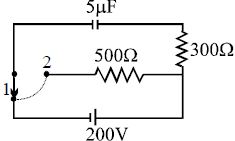
- 10A capacitor of capacitance $5\,\mu F$ is connected to a source of constant $emf$ of $200\,V$ for a long time, then the switch was shifted to contact $2$ from contact $1$ . The total amount of heat generated in the $500\,\Omega $ resistance, thereafter isView Solution