In previous problem, if the cell had been connected in parallel (instead of in series) which of the above graphs would have shown the relationship between total current $I$ and $n$?
- A
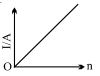
- B

- C

- D
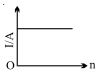
Medium

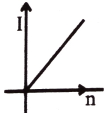

Download our appand get started for free
Experience the future of education. Simply download our apps or reach out to us for more information. Let's shape the future of learning together!No signup needed.*
Similar Questions
- 1A conducting wire of length $ l$ area of cross-section $A$ and electric resistivity $\rho$ is connected between the terminals of a battery. $A$ potential difference $V$ is developed between its ends, causing an electric current.If the length of the wire of the same material is doubled and the area of cross-section is halved, the resultant current would beView Solution
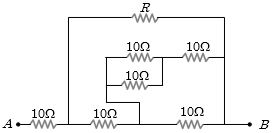
- 2For what value of $R$ the net resistance of the circuit will be $18\, ohms$ ............... $\Omega$View Solution
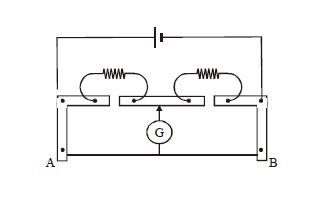
- 3A meter bridge set up as shown to determine end correction at $A$ and $B$. When a resistance of $15\ \Omega$ is used in left gap and of $20\ \Omega$ in right gap, then null point comes at a distance $42\ cm$ from $A$. When these resistances are interchanged null point comes at a distance $57\ cm$ from $A$. Values of end corrections areView Solution
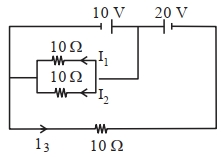
- 4In the given circuit the value of $\left|\frac{I_1+I_3}{I_2}\right|$ isView Solution
- 5When a potential difference $V$ is applied across a wire of resistance $R$, it dissipates energy at a rate $W$. If the wire is cut into two halves and these halves are connected mutually parallel across the same supply, the same supply, the energy dissipation rate will become:View Solution
- 6In an experiment of meter bridge, a null point is obtained at the centre of the bridge wire. When a resistance of $10\, ohm$ is connected in one gap, the value of resistance in other gap is ............. $\Omega$View Solution
- 7Current of $4.8\,A$ is flowing through a conductor. The number of electrons per second will beView Solution
- 8In a neon discharge tube $2.9 \times {10^{18}}\,N{e^ + }$ ions move to the right each second while $1.2 \times {10^{18}}$ electrons move to the left per second. Electron charge is $1.6 \times {10^{ - 19}}\,C$. The current in the discharge tubeView Solution
- 9In a balanced Wheatstone’s network, the resistances in the arms $Q$ and $S$ are interchanged. As a result of thisView Solution
- 10How many $60 \,W$ bulbs may be safely run on $220 \,V$ using a $5 \,A$ fuse is .........View Solution