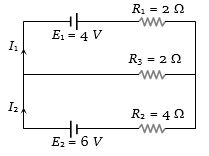
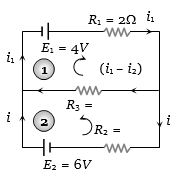
In the circuit shown below $E_1 = 4.0 \,V, R_1= 2 \Omega, E_2 = 6.0 \,V, R_2 = 4 \,\Omega$ and $R_3 = 2 \,\Omega$. The current $I_1$ is ..................... $A$
Diffcult


Download our appand get started for free
Experience the future of education. Simply download our apps or reach out to us for more information. Let's shape the future of learning together!No signup needed.*
Similar Questions
- 1The supply voltage to room is $120\ V$. The resistance of the lead wires is $6\,\Omega$ . A $60\ W$ bulb is already switched on. What is the decrease of voltage across the bulb, when a $240\ W$ heater is switched on in parallel to the bulb? ............. $V$View Solution
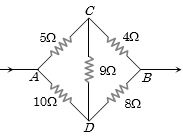
- 2Five resistors are connected as shown in the diagram. The equivalent resistance between $A$ and $B$ is .............. $ohm$View Solution
- 3If an electric heater is rated at $1000\, W$, then the time required to heat one litre of water from $20\,^oC$ to $60\,^oC$ isView Solution
- 4Two coils require $20$ minutes and $60$ minutes respectively to produce same amount of heat energy when connected separately to the same source. If they are connected in parallel arrangement to the same source; the time required to produce same amount of heat by the combination of coils, will be________ $min$View Solution
- 5A $100\, V$ voltmeter of internal resistance $20\,k\Omega $ in series with a high resistance $R$ is connected to a $110\, V$ line. The voltmeter reads $5\, V$, the value of $R$ is ................ $k \Omega $View Solution
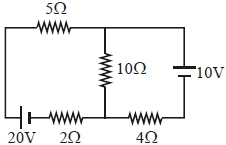
- 6Two rods of same material and length have their electric resistance in ratio $1:2$. When both rods are dipped in water, the correct statement will beView Solution
- 7A potentiometer wire of length $L$ and a resistance $r$ are connected in series with a battery of e.m.f. $E_0$ and a resistance $r_1$. An unknown e.m.f. $E$ is balanced at a length $l$ of the potentiometer wire. The e.m.f. $E$ will be given byView Solution
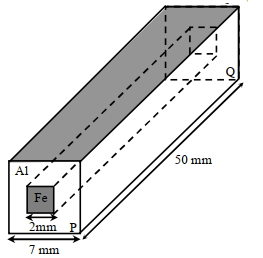
- 8In an aluminium $(A1)$ bar of square cross section, a square hole is drilled and is filled with iron ( $Fe$ ) as shown in the figure. The electrical resistivities of $A 1$ and $Fe$ are $2.7 \times 10^{-8} \ \Omega m$ and $1.0 \times 10^{-7} \ \Omega m$, respectively. The electrical resistance between the two faces $P$ and $Q$ of the composite bar isView Solution
- 9Two wires with resistances $R$ and $2R$ are connected in parallel, the ratio of heat generated in $2R$ and $R$ isView Solution
- 10In the figure shown, the current in the $10\, V$ battery is close toView Solution