In the circuit shown, $R_1$ is increased. What happens to the reading of the voltmeter (ideal)?
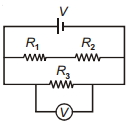
Easy
Download our app for free and get started
(d)
Voltmeter reading is always $V$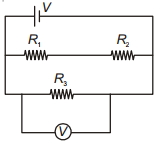

Download our appand get started for free
Experience the future of education. Simply download our apps or reach out to us for more information. Let's shape the future of learning together!No signup needed.*
Similar Questions
- 1An electric bulb of $500 \,watt$ at $100\, volt$ is used in a circuit having a $200\, {V}$ supply. Calculate the resistance ${R}$ to be connected in series with the bulb so that the power delivered by the bulb is $500\, {W}$. (in $\Omega$)View Solution
- 2The resistance of a bulb filmanet is $100\,\Omega$ at a temperature of $100\,^o C$. If its temperature coefficient of resistance be $0.005$ per $^o C$, its resistance will become $200\,\Omega$ at a temperature of ................ $^oC$View Solution
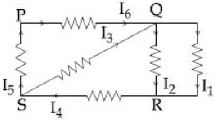
- 3In the given circuit diagram, the currents, ${I_1} = - \,0.3\,A,\,{I_4} = 0.8\,A$ and ${I_5} = 0.4\,A,$ are flowing as shown. The currents $I_2,\,I_3$ and $I_6,$ respectively areView Solution
- 4Two conductors have the same resistances at $0^{\circ} \mathrm{C}$ but their temperature coefficients of resistance are $\alpha_1$ and $\alpha_2$. The respective temperature coefficients for their series and parallel combinations are :View Solution
- 5In order to determine the $e.m.f.$ of a storage battery it was connected in series with a standard cell in a certain circuit and a current $I_1$ was obtained. When the battery is connected to the same circuit opposite to the standard cell a current $I_2$ flow in the external circuit from the positive pole of the storage battery was obtained. What is the $e.m.f$. $\varepsilon_1$ of the storage battery? The $e.m.f$. of the standard cell is $\varepsilon_2$.View Solution
- 6A $10\, ohm$ electric heater operates on a $110\, V$ line. Calculate the rate at which it develops heat in ............... $watts$View Solution
- 7View SolutionA wire of non-uniform cross-section is carrying a steady current. Along the wire
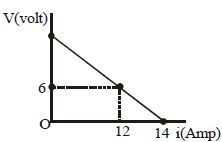
- 8$10\,Cells$, each of emf $'E'$ and internal resistance $'r'$, are connected in series to a variable external resistance. Figure shows the variation of terminal potential difference of their combination with the current drawn from the combination.$Emf$ of each cell is ............. $V$View Solution
- 9Two resistances ${R_1}$ and ${R_2}$ are made of different materials. The temperature coefficient of the material of ${R_1}$ is $\alpha $ and of the material of ${R_2}$ is $ - \beta $. The resistance of the series combination of ${R_1}$ and ${R_2}$ will not change with temperature, if ${R_1}/{R_2}$ equalsView Solution
- 10The resistance per centimeter of a meter bridge wire is $\mathrm{r}$, with $\mathrm{X}\ \Omega$ resistance in left gap. Balancing length from left end is at $40 \mathrm{~cm}$ with $25\ \Omega$ resistance in right gap. Now the wire is replaced by another wire of $2 \mathrm{r}$ resistance per centimeter. The new balancing length for same settings will be atView Solution