MCQ
On adjusting the $P-N $junction diode in forward biased
  • A
    Depletion layer increases
  • B
    Resistance increases
  • Both decreases
  • D
    None of these

Answer

Correct option: C.
Both decreases
c
(c)

Need a full question paper?

Generate a complete, print-ready paper with questions like this in minutes — across 16+ boards, with answer keys.

Start Generating Free

Similar questions

A $10$ metre wire kept in east-west falling with velocity $5 \,m/sec$ perpendicular to the field $0.3 \times {10^{ - 4}}Wb/{m^2}$. The induced e.m.f. across the terminal will be
A power transmission line feeds input power at $2300\,V$ to a step down transfonner with its primary windings having  $4000$ turns, giving the output power at $230\,V.$  If the current in the primary of the transformer is  $5\,A,$ and its efficiency is $90\%,$  the output current would be......$A$
Which of the following has a larger chromatic aberration?
Each quarter of a vessel of depth $H$ is filled with liquids of the refractive indices $n_1, n_2, n_3$ and $n_4$ from the bottom respectively. The apparent depth of the vessel when looked normally is
As compared to ${ }^{12} \mathrm{C}$ and ${ }^{14} \mathrm{C}$ atom has:
Consider two identical galvanometers and two identical resistors with resistance $R$. If the internal resistance of the galvanometers $R_{ C } < R / 2$

($A$) The maximum voltage range is obtained when all the components are connected in series

($B$) The maximum voltage range is obtained when the two resistors and one galvanometer are connected in series, and the second galvanometer is connected in parallel to the first galvanometer

($C$) The maximum current range is obtained when all the components are connected in parallel

($D$) The maximum current range is obtained when the two galvanometers are connected in series and the combination is connected in parallel with both the resistors
The total energy of an electron in an atom in an orbit is $-3.4 \;eV.$ Its kinetic and potential energies are, respectively
Magnetic induction is a
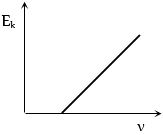
For the photoelectric effect, the maximum kinetic energy ${E_k}$ of the emitted photoelectrons is plotted against the frequency $v$ of the incident photons as shown in the figure. The slope of the curve gives
In nuclear reactions, we have the conservation of