Question
Read the following and answer any four questions from (i) to (v) given below:
Mutation explains the relationship between gene and DNA. The effects of large deletions and rearrangement in a segment of DNA results in loss or gain of gene and its function. Insertion or deletion of one or two bases changes the reading frame from the point of insertion or deletion. A classical example of point mutation is a change of single base pair in the gene for beta globin chain that results in change of amino acid residue glutamate to valine and results into a diseased condition called sickle cell anaemia.
  1. A mutation is a change produced by an alteration in the genetic mechanism and.
  1. May arise spontaneously.
  2. Is always induced by the environment.
  3. Is never advantageous.
  4. Is not inherited.
  1. The DNA code for glutamic acid is CTC or CTT. The code for valine is CAA or CAT. In sickle cell haemoglobin, valine is present instead of glutamic acid.
Assuming a single base pair substitution has occurred, what is the mRNA code in the affected mutant?
  1. CUU
  2. GAA
  3. GAG
  4. GUA
  1. A mutation involving the substitution of one nitrogenous base for another has altered the base sequence of a DNA molecule, coding for four amino acids, as shown below.
Normal A-G-C-A-T-G-G-A-T-C-C-T

Mutant A-G-C-A-T-G-C-A-T-C-C-T
The table shows six codons and the corresponding amino acids into which each is translated.
mRNA codon
Amino acid
AAG
Lysine
CUA
Leucine
GGA
Glycine
GUA
Valine
UAC
Tyrosine
UCG
Serine
The mutation has changed the amino acid.
  1. Leucine to valine.
  2. Lysine to glycine.
  3. Serine to leucine.
  4. Tyrosine to lysine.
  1. Assertion : Insertion or deletion of three or its multiple bases, insert or delete one or multiple codons and so one or multiple amino acids.
Reason: Reading frame remains unaltered with insertion or deletion of three or its multiple bases.
  1. Both assertion and reason are true, and reason is the correct explanation of assertion.
  2. Both assertion and reason are true, but reason is not the correct explanation of assertion.
  3. Assertion is true, but reason is false.
  4. Both assertion and reason are false.
  1. Part of the amino acid sequences in normal and sickle cell haemoglobin are shown.
Normal haemoglobin Sickle cell haemoglobin
Thr-Pro-Glu-Glu Thr-Pro-Val-Glu
mRNA codons for these amino acids are
Glutamine (Glu) GAA GAG
Praline (Pro) CCU CCC
Threonine (Thr) ACU ACC
Valine (Val) GUA GUG
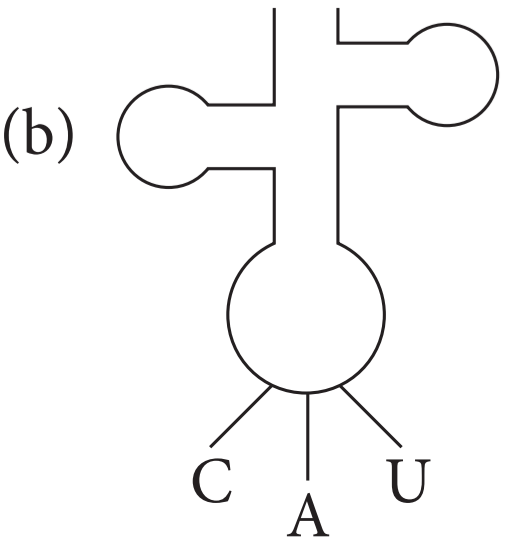
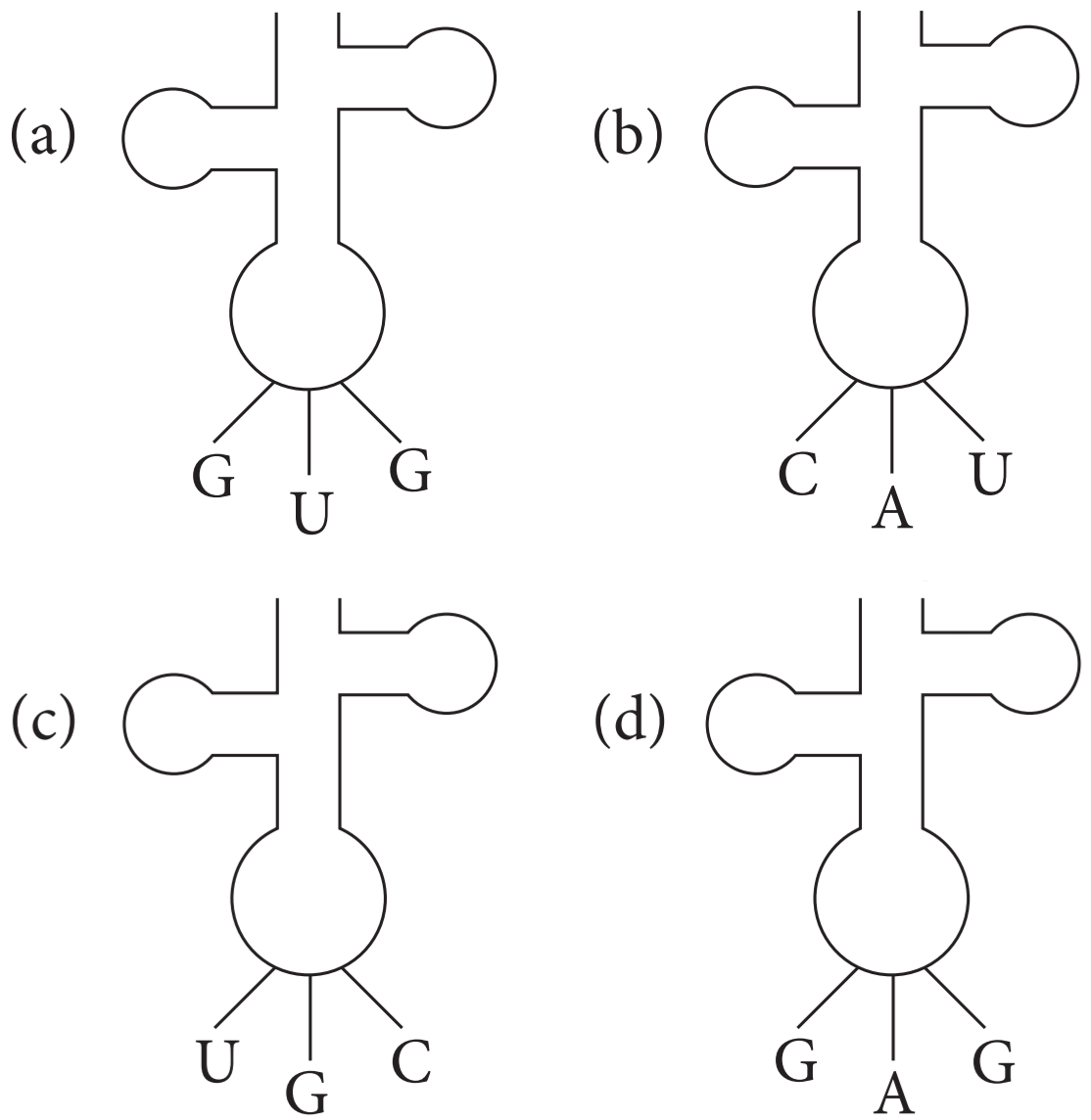
Which transfer RNA molecule is involved in the formation of this part of the sickle cell haemoglobin?
Answer

  1. (a) May arise spontaneously.
Explanation:

A mutation is a change in the DNA that changes the physiological effect of the DNA on the cell. Such phenomenon may be caused by radiation, chemical carcinogens, or may occur spontaneously.
  1. (d) GUA
Explanation:

Since a single base pair substitution has caused this mutation, the original codon for glutamic acid must have been CTT, and the mutant codon is CAT. The mRNA code for this mutant is hence GUA, i.e., complementary to CAT.
  1. (a) Leucine to valine.
Explanation:

The segment coding for GAT on the normal DNA molecule has been transcribed into CUA in the mRNA molecule, therefore the mutant DNA strand CAT will be transcribed into GUA on the mRNA molecule. This implies a change from the amino acid leucine to valine.
  1. (b) Both assertion and reason are true, but reason is not the correct explanation of assertion.
  2. (b)
Explanation:

CAU in tRNA is the only one that can compliment the valine in the sickle cell haemoglobin.

Need a full question paper?

Generate a complete, print-ready paper with questions like this in minutes — across 16+ boards, with answer keys.

Start Generating Free

Similar questions

Distinguish between : Cranial nerves and Spinal nerves
Distinguish between: Spermatogenesis and Oogenesis.
Respiratory surfaceOrganism
(1) Plasma membrane(a) Insect
(2) Lungs(b) Salamander
(3) External gills(c) Bird
(4) Internal gills(d) Amoeba
(e) Fish
Read the following and answer any four questions from (i) to (v) given below:
ABO blood groups in human beings are controlled by the gene. The gene I has three alleles. $I^A, I^B$ and $i$. Since there are three different alleles six different genotypes are possible. If two persons with 'AB' blood group marry and have sufficient large number of children, there children could be classified as 'A: blood group : 'AB' blood group : B blood group in $1 : 2 : 1$ ratio. Modern technique of protein electrophoresis reveals presence of both 'A and 'B' type proteins in 'AB' blood group individuals.
  1. How many types of phenotypes can occur in ABO blood group?
  1. Six
  2. Two
  3. Three
  4. Four
  1. ABO blood grouping in human beings cites the example of.
  1. Incomplete dominance.
  2. Co-dominance.
  3. Multiple allelism.
  4. both (b) an (c).
  1. The presence of both 'X and 'B' type proteins in 'AB' blood group individuals is an example of.
  1. Partial dominance.
  2. Incomplete dominance.
  3. Co-dominanc.
  4. complete dominance.
  1. If a man of A blood group marries a woman of AB blood group. Which type of progeny indicates that man is heterozygous?
  1. O
  2. B
  3. A
  4. AB
  1. Complete the given table regarding different possibilities and their corresponding blood groups.
Genotypes
Blood group
$I^AI^B$
$(I)$
$I^B i, (II)$
$B$
$(III)$
$O$
$I^A I^A, (IV)$
$I^A$
 
 
(I)
(II)
(III)
(IV)
(a)
O
$I^B I^B$
$I^B i$
$I^A i$
(b)
AB
$I^A i$
$I^A I^B$
$IBi$
(c)
AB
$I^B I^B$
$ii$
$I^A i$
(d)
O
$I^A I^A$
$ii$
$I^A i$
Distinguish between: Asexual reproduction and Sexual reproduction.
Match the layer of adrenal with its hormone.
Column A (Layers of adrenal cortex)Column B (Hormones)
(1) Zona glomerulosa (A) Cortisols
(2) Zona fasciculata(B) Androgens
(3) Zona reticularis(C) Aldosterone
Distinguish between: Passive absorption of Minerals and Active absorption of minerals
Read the following and answer any four questions from (i) to (v) given below:
Pollen-pistil interaction is the group of events that occur from the time of pollen deposition over the stigma to the time of pollen tube entry into ovule. It is a dynamic process which has checks at several places for promotion or inhibition of pollen growth. Pollen-pistil interaction is a safety measure to ensure that illegitimate crossings do not occur. Compatibility and incompatibility of the pollen-pistil is determined by special proteins. The compatible pollens are able to absorb water and nutrients from the surface of the stigma. They germinate and produce pollen tubes. Pollen tubes grow into the style. Their growth and path through the style are also determined by specific chemicals.
  1. Which of the following parts of gynoecium determines the compatible nature of pollen?
  1. Stigma.
  2. Style.
  3. Ovary.
  4. Thalamus.
  1. In Triforium, which type of self-incompatibility is found?
  1. Gametophytic self-incompatibility (GSI).
  2. Sporophytic self-incompatibility (SSI).
  3. Both GSI and SSI.
  4. None of these.
  1. Select the incorrect statement.
  1. In Asteraceae, incompatibility is due to the genotype of the sporophytic stigmatic tissues.
  2. In members of Brassicaceae, incompatibility is due to the genotype of the pollen.
  3. Nature has imposed self-incompatibility to avoid highly homozygous individuals, which have a very low survival value.
  4. None of these.
  1. Which of the following are examples of self incompatibility?
  1. Tobacco.
  2. Potato.
  3. Crucifers.
  4. All of these.
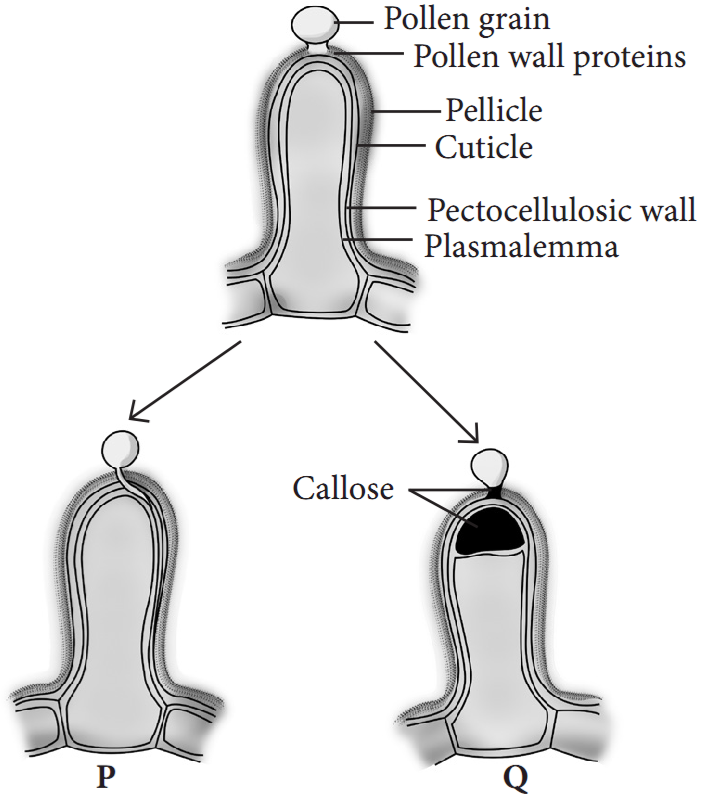
  1. Given figures show the pollen-stigma interaction, where pollen wall proteins are released onto the pellicle of stigmatic papillae, where a recognition reaction occurs.


Which of the following statements drawn from given figures is incorrect?
  1. P indicates compatible reaction in which the pollen tube penetrates the cuticle and grows down the papilla.
  2. Development of callose plug between the plasma membrane and pectocellulosic layer of stigmatic papillae results in the incompatibility reaction in Q.
  3. A callose plug, which appears at the tip of pollen in Q, is dissolved by callase enzyme secreted by stigma resulting in compatibility reaction.
  4. Deposition of callose can be employed as a reliable bioassay to detect compatibility or incompatibility reactions of pollen and stigma.
Column AColumn B (Organisms)
1. Symbiotic nitrogen fixationa. Nitrobacter
2. Denitrificationb. Cyanobacteria
3. Free living nitrogen fixersc. Rhizobium
4. Nitrificationd. Paracoccus
Column AColumn B
(1) Pioneer species(a) Entire gradient of communities
(2) Climax species(b) Spatial pattern
(3) Succession(c) Quercus
(4) Sere(d) Crustose lichen