Question
Distinguish between: Spermatogenesis and Oogenesis.

Answer

SpermatogenesisOogenesis
1. Spermatogenesis takes place in testis in mature and fertile males.1. Oogenesis takes place in ovaries in mature and fertile females.
2. From one spermatogonium four haploid sperms are formed during spermatogenesis.2. From one oogonium one haploid ovum and a polar body is formed during oogenesis.
3. Spermatid developed undergoes metamorphosis in the process of spermiogenesis.3. There is no such process of metamorphosis in oogenesis.
4. Spermatid development takes place which later becomes a functional sperm.4. Ootid development does not take place during oogenesis. It develops only after fertilization.
5. Spermatogonia, primary and secondary spermatocytes and spermatid are the stages of sperms formed during spermatogenesis.5. Oogonia, primary and secondary oocytes are the stages formed during oogenesis. Ootid formation occurs only after fertilization.

Need a full question paper?

Generate a complete, print-ready paper with questions like this in minutes — across 16+ boards, with answer keys.

Start Generating Free

Similar questions

Distinguish between: Allopatric and Sympatric speciation.
Distinguish between: Zona pellucida and Corona radiata.
Read the following and answer any four questions from (i) to (v) given below:
Over population causes number of family problems. Strategies like birth control methods help to control population explosion. Natural methods of birth control do not involve medications or devices to prevent pregnancy, but rather rely on behavioural practices and/ or making observations about menstrual cycle.
  1. Which method helps in contraception by temporary absence of sex?
  1. Coitus interruptus.
  2. Withdrawal method.
  3. Rhythm method.
  4. Lactational amenorrhea method.
  1. Assertion: The effectiveness of coitus interruptus method is limited.
Reason: Some sperms may pass into vagina before ejaculation.
  1. Both assertion and reason are true, and reason is the correct explanation of assertion.
  2. Both assertion and reason are true, but reason is not the correct explanation of assertion.
  3. Assertion is true, but reason is false.
  4. Both assertion and reason are false.
  1. Why is lactational amenorrhea effective for about 4-5 months after parturition?
  1. Ovulation occurs on about the $14^{th}$ day of menstruation.
  2. Ovulation does not occur during intense lactation.
  3. This method inhibits mobility of sperms.
  4. Both (b) and (c).
  1. Which fact is not the basis of periodic absence method of birth control?
  1. Ovum remains alive for about 1-2 days.
  2. Ovulation occurs on about $14^{th}$ day of menstruation.
  3. Sperms survive for about 3 days.
  4. Alteration in uterine endometrium.
  1. On which days of menstrual cycle should coitus be avoided to prevent fertilisation?
  1. 10-17
  2. 6-13
  3. 1-5
  4. 15-28
Distinguish between : Single circulation and Double circulation.
Read the following and answer any four questions from (i) to (v) given below:
Study the given table and answer the questions based on it.
 
Hormone
Source
Function
(A)
Oxytocin
W
Ejection of milk
(B)
X
Anterior lobe of pituitary gland
Stimulates secretion of ABP from Sertoli cells
(C)
Y
Placenta
Maintains corpus luteum to secrete progesterone
(D)
Relaxin
Ovary
Z
  1. Identify the hormones X and Y, respectively.
  1. Testosterone, FSH.
  2. LH, hPL.
  3. FSH, hCG.
  4. ICSH, hCG.
  1. W in the given table is:
  1. Hypothalamus.
  2. Posterior lobe of pituitary.
  3. Placenta.
  4. Ovary.
  1. Which of the following is correct for Z?
  1. Dilation of uterine cervix during labour pains.
  2. Stimulates the growth of the mammary glands during pregnancy.
  3. Supports the fetal growth and prevents desiccation.
  4. Forms protective plug in cervix of uterus during pregnancy.
  1. Which set of hormones is secreted only during pregnancy?
  1. Human chorionic gonadotropin, relax in and human placental lactogen.
  2. Human placental lactogen, estrogen and chorionic thyrotropin.
  3. Human chorionic gonadotropin, human placental lactogen and progesterone.
  4. Chorionic thyrotropin, chorionic gonadotropin and estrogen.
  1. Assertion: Follicle stimulating hormone controls the maintenance and functions of male reproductive organs.
Reason: FSH acts directly on spermatogonia to stimulate sperm production.
  1. Both assertion and reason are true, and reason is the correct explanation of assertion.
  2. Both assertion and reason are true, but reason is not the correct explanation of assertion.
  3. Assertion is true, but reason is false.
  4. Both assertion and reason are false.
Distinguish between: Autogamy (Self-pollination) – Xenogamy (cross pollination)
Distinguish Between: Homozygous and Heterozygous.
What is the cause of frameshift mutation?
Read the following and answer any four questions from S(i) to S(v) given below:
Rajat is a student of biotechnology. His professor tells him that for transformation with recombinant DNA the bacterial cells must be made capable of taking up DNA as DNA do not pass through membrane. While doing experiment in the lab, Rajat noticed that bacterial cells were not taking up the foreign DNA even after treating it with sodium ion. He asked his professor, the reason behind this. His professor explained that he should check the valency and charge of the ion that he is using for the treatment.
  1. It is difficult for DNA to pass through the membrane as
  1. It is a hydrophilic molecule.
  2. It is a hydrophobic molecule.
  3. It is a circular molecule.
  4. It changes its shape when it comes in contact with host cell.
  1. What type of ions are used for DNA mediated gene transfers?
  1. Divalent anions.
  2. Divalent cations.
  3. Monovalent cations.
  4. Monovalent anions.
  1. rDNA stands for,
  1. reduced DNA
  2. red DNA
  3. recombinant DNA
  4. related DNA.
  1. Which of the following statements with regard to DNA is correct?
  1. DNA is a positively charged molecule having two polynucleotide chains.
  2. Nitrogen bases of two polynucleotide chain form complementary pairs, i.e., A opposite G and T opposite C.
  3. Backbone of DNA chain is built up of alternate deoxyribose sugar and phosphate group.
  4. Both (a) and (c)
  1. Assertion: Competent host is essential for transformation with rDNA.
Reason: Transfer of DNA in a prokaryotic cell is called transfection.
  1. Both assertion and reason are true and reason is the correct explanation of assertion.
  2. Both assertion and reason are true but reason is not the correct explanation of assertion.
  3. Assertion is true but reason is false.
  4. Both assertion and reason are false.
Read the following and answer any four questions from (i) to (v) given below:
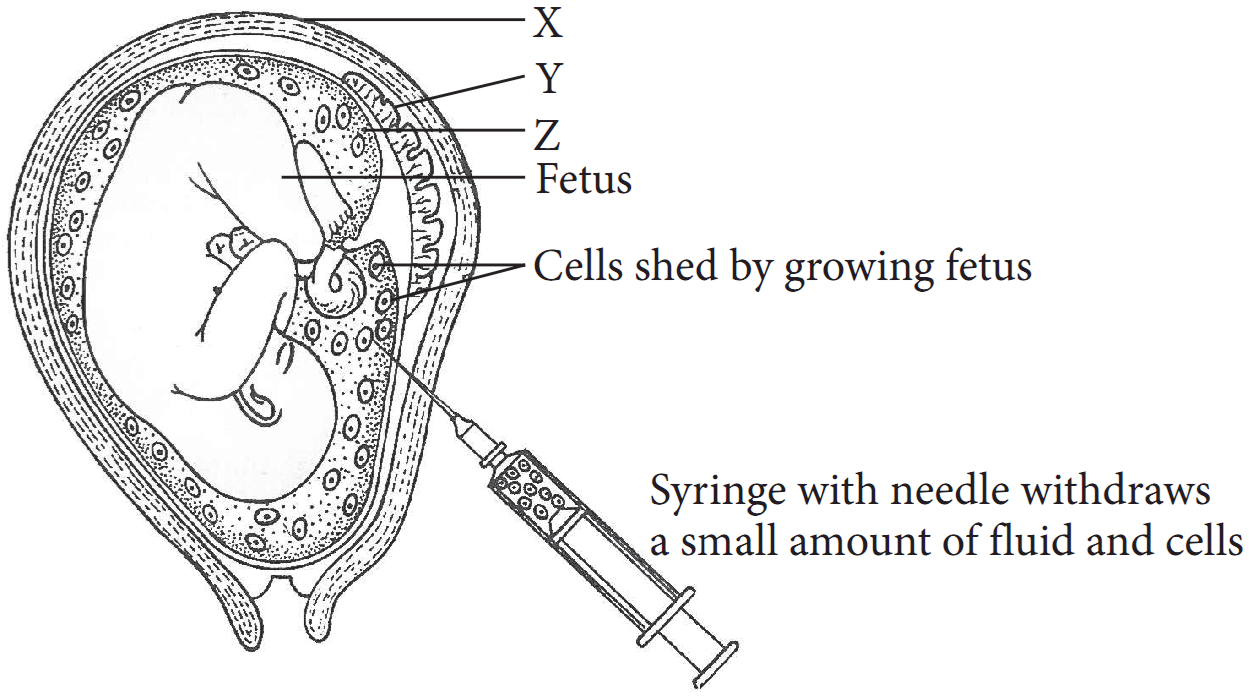
A technique known as amniocentesis is used to determine fetal abnormalities. This test chromosomal pattern in amniotic fluid. However, this technique is legally banned now.
  1. Identify X and Y in the above given figure.
S. No
X
Y
(a)
Amnion
Chorion
(b)
Uterine wall
Placenta
(c)
Placenta
Uterine wall
(d)
Uterine wall
Amnion
  1. What is the function of Z?
  1. Z is an amniotic fluid which prevents dessication of an embryo.
  2. Z is yolk sac which functions as site of early blood cell formation.
  3. Z is amnion, which takes part in placenta formation.
  4. None of these
  1. Which of the following diseases can not be diagnosed by amniocentesis?
  1. Down's syndrome.
  2. Sickle cell disease.
  3. Jaundice.
  4. Cystic fibrosis.
  1. Assertion: Amniocentesis is legally banned for sex determination.
Reason: Amniocentesis was being misused for aborting normal female fetus.
  1. Both assertion and reason are true, and reason is the correct explanation of assertion.
  2. Both assertion and reason are true, but reason is not the correct explanation of assertion.
  3. Assertion is true, but reason is false.
  4. Both assertion and reason are false.
  1. Which of these is a non-invasive technique of detecting fetal disorder?
  1. Fetoscopy.
  2. Chorionic villi sampling.
  3. Amniocentesis.
  4. Ultrasound imaging.