${T}_{0}$ is the time period of a simple pendulum at a place. If the length of the pendulum is reduced to $\frac{1}{16}$ times of its initial value, the modified time
JEE MAIN 2021, Easy


Download our appand get started for free
Experience the future of education. Simply download our apps or reach out to us for more information. Let's shape the future of learning together!No signup needed.*
Similar Questions
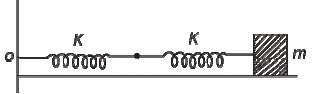
- 1The frequency of oscillations of a mass $m$ connected horizontally by a spring of spring constant $k$ is $4 Hz$. When the spring is replaced by two identical spring as shown in figure. Then the effective frequency is,View Solution
- 2A particle is executing a simple harmonic motion. Its maximum acceleration is $\alpha$ and maximum velocity is $\beta$. Then, its time period of vibration will beView Solution
- 3A particle executes $SHM.$ Its velocities are $v_1$and $v_2$ at displacement $x_1$ and $x_2$ from mean position respectively. The frequency of oscillation will beView Solution
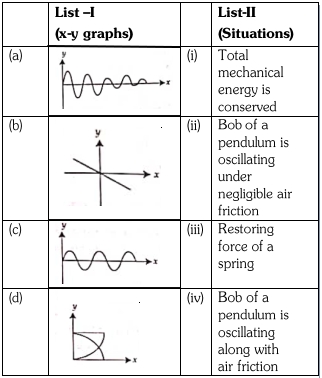
- 4Match $List - I$ with $List - II$View Solution
Choose the correct answer from the options given below
- 5Four harmonic waves of equal frequencies and equal intensities $I_0$ have phase angles $0, \pi / 3,2 \pi / 3$ and $\pi$. When they are superposed, the intensity of the resulting wave is $nI _0$. The value of $n$ isView Solution
- 6A particle executes simple harmonic motion with a frequency $f$. The frequency with which its kinetic energy oscillates isView Solution
- 7For any $S.H.M.$, amplitude is $6\, cm$. If instantaneous potential energy is half the total energy then distance of particle from its mean position is .... $cm$View Solution
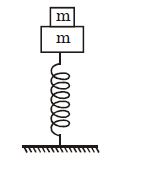
- 8A block of mass $m$ is at rest on an another block of same mass as shown in figure. Lower block is attached to the spring, then the maximum amplitude of motion so that both the block will remain in contact isView Solution
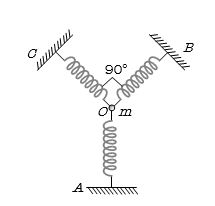
- 9A particle of mass $m$ is attached to three identical springs $A, B$ and $C$ each of force constant $ k$ a shown in figure. If the particle of mass $m$ is pushed slightly against the spring $A$ and released then the time period of oscillations isView Solution
- 10A body performs $S.H.M.$ Its kinetic energy $K$ varies with time $t$ as indicated by graphView Solution