The amplitude of an oscillating simple pendulum is $10\,cm$ and its period is $4\, sec$. Its speed after $1\, sec$ after it passes its equilibrium position, is ... $m/s$
Easy
Download our app for free and get started
(a) At the time $t = \frac{T}{4} = \frac{4}{4} = 1\sec $ after passing from mean position, the body reaches at it's extreme position. At extreme, position velocity of body becomes zero.

Download our appand get started for free
Experience the future of education. Simply download our apps or reach out to us for more information. Let's shape the future of learning together!No signup needed.*
Similar Questions
- 1If a simple pendulum is taken to place where g decreases by $2\%$, then the time periodView Solution
- 2The period of small oscillation of a simple pendulum is $T$. The ratio of density of liquid to the density of material of the bob is $\rho \left( {\rho < 1} \right)$.When immersed in the liquid, the time period of small oscillation will now beView Solution
- 3A spring of force constant $k$ is cut into two pieces such that one piece is double the length of the other. Then the long piece will have a force constant ofView Solution
- 4View SolutionThe phase difference between displacement and acceleration of a particle in a simple harmonic motlon is
- 5View SolutionA tunnel has been dug through the centre of the earth and a ball is released in it. It will reach the other end of the tunnel after
- 6A pendulum is executing simple harmonic motion and its maximum kinetic energy is $K_1$. If the length of the pendulum is doubled and it performs simple harmonic motion with the same amplitude as in the first case, its maximum kinetic energy is $K_2$ thenView Solution
- 7A block of mass $m$ is suspended separately by two different springs have time period $t_1$ and $t_2$ . If same mass is connected to parallel combination of both springs, then its time period will beView Solution
- 8View SolutionIn the situation as shown in figure time period of vertical oscillation of block for small displacements will be
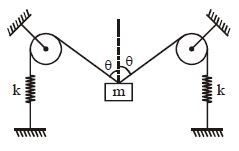
- 9An object is attached to the bottom of a light vertical spring and set vibrating. The maximum speed of the object is $15\, cm/sec$ and the period is $628$ milli-seconds. The amplitude of the motion in centimeters isView Solution
- 10View SolutionThe period of a simple pendulum is doubled, when